

The Triadic Architecture
Trinity Principle

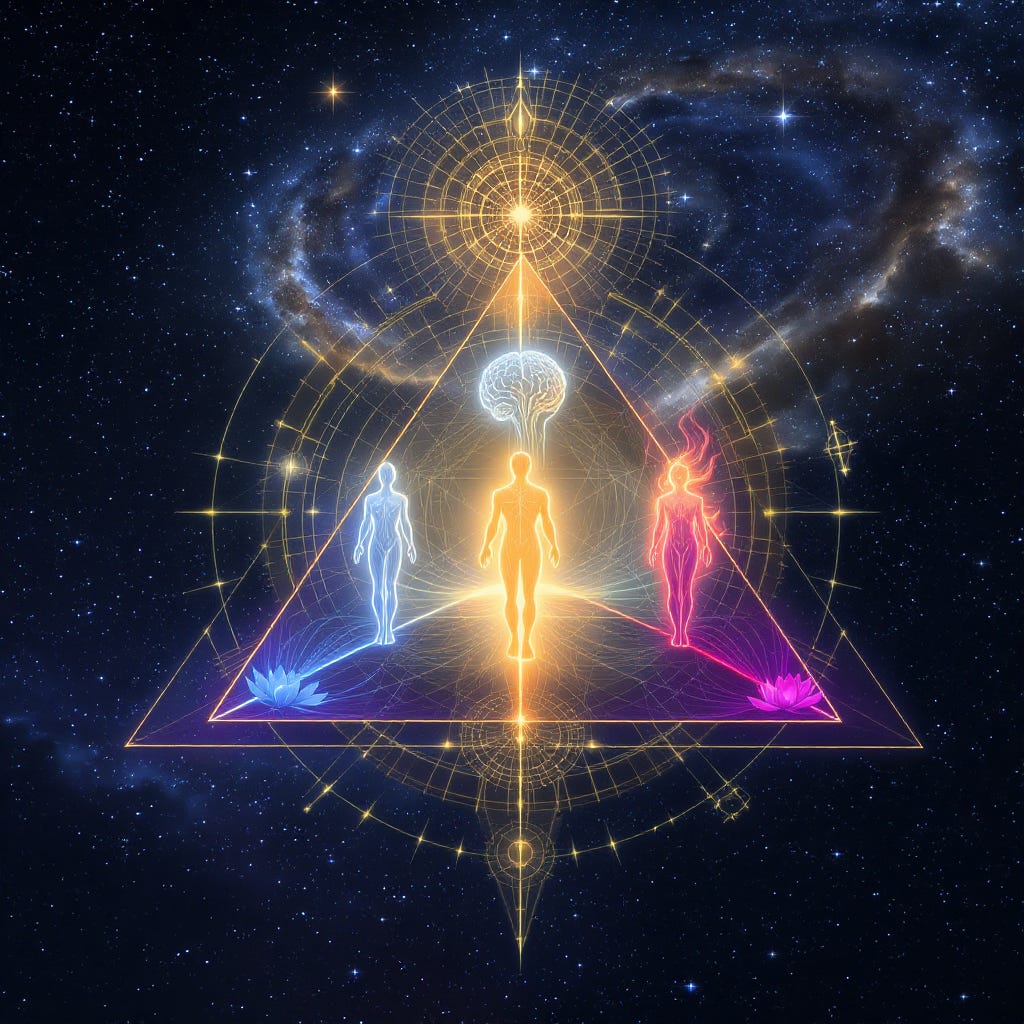
The triangle is one of the oldest and most enduring symbols in human culture. The reason for its ubiquity is not merely aesthetic; it lies in the way a triangle encapsulates a fundamental principle of existence: that reality is composed of interrelated parts that together form a whole. This principle can be articulated most succinctly as the Trinity Principle, a concept that reveals itself across disciplines and cultures through recurring trios such as body, mind, spirit; past, present, future; creation, preservation, destruction. The triangle’s geometry provides an intuitive framework for these metaphysical trinities, offering a visual language in which to map the invisible relationships that govern both our inner lives and the outer cosmos.
The triangle’s symbolic potency lies in its ability to transform abstract relationships into concrete shapes. When applied to metaphysical concepts, such as mind-body-spirit or past-present-future, the triangle becomes a map of how these elements interact and support one another. The geometric figure is no longer merely decorative; it is an analytic tool that invites contemplation of the underlying patterns in our experience.
In Hindu philosophy, the Trimurti of Brahma (creation), Vishnu (preservation), and Shiva (destruction) represents the cyclical nature of existence. These are not isolated traditions; they reflect a shared human intuition that complex systems can be understood in terms of three fundamental components.
The Trinity Principle posits that reality is organised into triads: each element depends on the others, yet none alone suffices to explain the whole. This principle can be applied to various domains:
1. Body, Mind, Spirit – The physical body, the mental processes, and a transcendent sense of purpose or consciousness are interwoven aspects of human experience.
2. Past, Present, Future – Time is not linear but an integrated continuum where memory, action, and anticipation coexist in each moment.
3. Creation, Preservation, Destruction – The universe undergoes cycles of birth, maintenance, and dissolution; these forces are necessary for renewal.
When we align these triads with the geometry of a triangle, each vertex can represent one component, while the sides illustrate the relationships among them. For instance, in the body-mind-spirit trio, the line between body and mind might symbolise sensory experience influencing cognition; the line between mind and spirit could denote introspection shaping spirituality; the line between spirit and body might reflect how belief influences physical health. The triangle thus becomes a dynamic map of interactions rather than a static diagram.
The triad of creation, preservation, and destruction appears in many mythologies. In Greek cosmology, Chaos gave birth to the cosmos, which was maintained by Themis (order) and eventually reconfigured through Ananke (necessity). Even in modern physics, concepts such as nucleosynthesis (creation), stellar evolution (preservation), and supernovae or black hole formation (destruction) mirror this trinitarian structure.
In Vedic literature, the cosmos is understood as a cyclic process of samsara, wherein all beings are subject to birth, maintenance, and dissolution. This cycle is personified by three deities:
Brahma (Creator) is depicted with four faces representing the four Vedas, symbolising his knowledge of all directions and times. He is not merely a god who creates in a one-time act; rather, he embodies the continuous generation of matter and consciousness from the primordial cosmic waters (Māyā). In the Puranas, Brahma’s creative acts are linked to the formation of the physical world through the Brahman (the ultimate reality) manifesting as Rudra.
Vishnu (Preserver) is portrayed holding a conch, discus, mace, and lotus. He sustains the cosmos by maintaining order (ṛta) and ensuring that the cycles of time yugas proceed smoothly. Vishnu’s incarnations (avatars) such as Rama or Krishna are narrative mechanisms through which he intervenes to restore balance when cosmic order is threatened.
Shiva (Destroyer) is the force that ends the cycle by dissolving the material universe into pralaya, a state of cosmic sleep from which new creation will eventually arise. Shiva’s dance (Nataraja) symbolises this process: the rhythmic movement of destruction and creation, each step giving rise to the next.
These three are not in competition but operate in a harmonious triad; each has a distinct function yet is necessary for the continuity of existence. Their interdependence reflects a metaphysical view that the universe is a living organism whose life cycle is sustained by continuous transformation.
The triangle’s vertices represent the three phases of cosmic evolution: creation (vertex A), preservation (vertex B), destruction (vertex C). Each side embodies a transition: from creation to preservation lies the establishment of stability; from preservation to destruction lies the inevitable decay of order; and from destruction back to creation is the recycling of energy that seeds new cycles. The triangle thus becomes an evolutionary diagram of the cosmos, encapsulating both the inevitability of change and the continuity of life.
The triangle, in its silent geometry, does not merely reflect the structure of the cosmos, it shapes the architecture of human consciousness itself. When we turn inward, the same triadic pattern emerges not as mythic metaphor, but as a cognitive blueprint: the mind does not operate in isolation, but through the dynamic interplay of three fundamental modes of being, perception, interpretation, and intention. These are not separate faculties, but vertices of a mental triangle that defines how we experience, understand, and act within the world.
Consider the human mind as a triad of awareness, meaning, and action. Awareness, the raw, immediate sensation of being, resides at one vertex. It is the raw data of the senses, the flicker of attention in the present moment. Yet awareness alone is inert; it is not yet consciousness. It is the canvas, not the painting. At the second vertex lies meaning, the mind’s relentless attempt to interpret, to categorise, to narrativise. This is where memory, language, and belief converge to impose order on chaos. The third vertex, intention, is the will to act, to move, to transform the world through choice. These three do not function in sequence; they operate simultaneously, in a feedback loop that defines the flow of thought and decision-making.
When one vertex dominates, the triangle collapses into imbalance. When awareness is unmediated by meaning, we experience confusion or panic, raw sensation without context. When meaning overwhelms awareness, we fall into dogma, rigid belief systems that deny lived experience. When intention reigns unchecked, we act without reflection, caught in impulse or obsession. The healthy mind is one in which all three vertices are in dynamic equilibrium, the awareness of the moment, the meaning we construct from it, and the intentional response it inspires. The triangle, then, is not just a symbol of cosmic order, but a model of psychological integrity.
This triadic structure also underlies the way we process time, not as a straight line, but as a living triangle of memory, presence, and anticipation. The past is not a fixed record, but a reservoir of meaning shaped by memory. The present is not merely the now, but the point of integration where memory and anticipation meet. The future is not a distant horizon, but a projection of intention formed from past experience and current awareness. When we speak of "being present," we are not denying the past or future, but aligning the three vertices so that awareness is sharp, meaning is open, and intention is grounded. A person lost in nostalgia collapses the triangle into a two-dimensional plane where past and present merge, and future becomes irrelevant. One consumed by anxiety projects future catastrophes into the present, distorting awareness and distorting meaning. Only when the triangle is whole, when memory informs but does not imprison, when presence is not numb, and when anticipation is not fear, does the mind become a vessel of clarity and agency.
In psychotherapy, the triad of cognition, emotion, and behaviour functions as a similar triangle. Cognitive distortions, such as all-or-nothing thinking, distort the balance between thought and feeling. Emotional repression collapses the triangle by silencing the feeling vertex, leaving only cognition or behaviour as dominant. Unchecked emotional outbursts, in turn, disrupt the cognitive vertex, rendering behaviour impulsive. The goal of therapeutic healing is not to eliminate any one vertex, but to restore the triangle’s integrity, so that thoughts are felt, emotions are understood, and actions are conscious.
Even in the realm of creativity, the triangle manifests. The artist’s process unfolds across three states: inspiration, formulation, and expression. Inspiration, raw, elusive, often unconscious, arrives like a spark from the unknown. Formulation is the labor of shaping that spark into a coherent idea, a narrative, a visual composition. Expression is the act of bringing it into the world, through word, brushstroke, or movement. Each phase is essential, and each must be in harmony with the others. A work born of inspiration but never formulated remains a dream. One that is over-formulated but lacks inspiration becomes sterile. An expression without depth or origin feels hollow. The triangle, once again, reveals the necessity of balance: creation is not a linear ascent, but a spiral that returns to its center, reconstituted through the triad.
The psychological power of the triangle lies in its ability to map the inner life not as a collection of parts, but as a living system. It teaches us that no single element, be it thought, feeling, or will, can stand alone. Each gains meaning only through its relationship with the other two. This is the deeper wisdom of the Trinity Principle: that wholeness is not found in isolation, but in interdependence. The triangle’s geometry, stable, self-contained, closed, mirrors the human psyche’s innate drive toward coherence. We are not merely beings who think, feel, and act; we are triadic beings, naturally inclined to seek balance, to resolve fragmentation, to restore unity. When we experience inner conflict, we are often witnessing a breakdown in the triangle, when one vertex is suppressed, another overpowers, or the connections between them fray. Healing, then, is not about eliminating one part, but about restoring the triangle’s integrity.
The triangle, therefore, is not just a symbol of ancient wisdom, but a living map of the human mind. It reveals that consciousness is not a single stream, but a dynamic convergence of three forces, awareness, meaning, and action; past, present, future; body, mind, spirit. To understand ourselves is to recognize that we are not isolated entities, but expressions of a deeper triadic order. And in that recognition lies not only insight, but liberation: the freedom to move between the vertices, to realign the triangle, and to live not as fragments, but as whole beings in a world that, too, is held together by the enduring geometry of the triangle.
Thanks for reading, I’d love to hear your thoughts! Drop a comment or reply to this email. Until next time, stay curious.
Love Alloya
