

The Four Directions Within
A Journey Through the Medicine Wheel

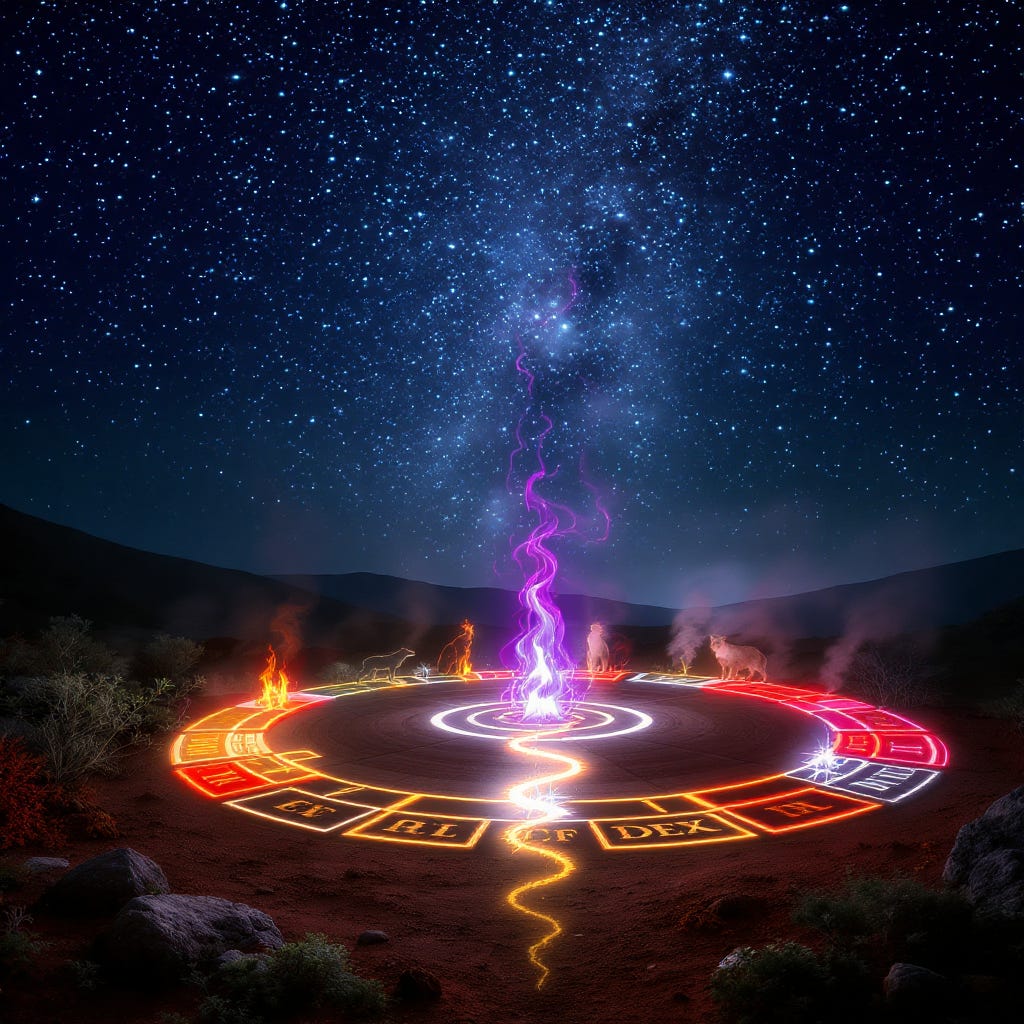
The Medicine Wheel serves as a profound map for navigating the inner landscape of the self while fostering a deep connection to the cycles of nature, community, and spirit. As a comprehensive framework for self-discovery and integration, it offers individuals a structured yet adaptable path toward greater self-awareness, emotional healing. At its essence, the Medicine Wheel functions as a "spiritual compass", guiding individuals through the cyclical nature of life, birth, growth, challenge, death, and renewal. Its circular form embodies the interconnectedness of all things: the four seasons, stages of life, elements, directions, and dimensions of being, mental, emotional, physical, and spiritual.
Unlike linear models of progress common in Western thought, the Medicine Wheel emphasizes wholeness, continuity, and balance. It teaches that true wellness arises not from fixing isolated problems but from understanding how all aspects of the self are interwoven. When one quadrant falls out of alignment, the entire system feels the strain. Thus, the journey of self-discovery through the Medicine Wheel is not about perfection or elimination of difficulty, but about cultivating awareness, restoring equilibrium, and honouring the sacred.
The Medicine Wheel is typically structured as a circle divided into four quadrants by a cross, representing the cardinal directions: East, South, West, and North. Each direction carries symbolic associations with seasons, stages of life, elements, animals, plants, and aspects of being. Together, they form a holistic map of existence that mirrors both the outer world and the inner self. The circle itself is the most fundamental symbol. It reflects the cyclical patterns of nature, the sun’s daily journey, the changing seasons, the lunar phases, and the life-death-rebirth cycle. It also represents wholeness and interconnectedness, reminding us that all things are part of a greater whole.

The Medicine Wheel is often described as the "circle of awareness of the individual self" and the "circle of knowledge" that empowers individuals to direct their lives. It symbolizes both the vast universe and the "little universe" of the individual mind and spirit, suggesting a fractal relationship between the macrocosm and microcosm. By understanding and balancing the self, one gains insight into universal patterns; by recognizing universal patterns, one finds meaning in personal experience.
The four sacred directions provide a detailed map for self-exploration:
East (Yellow/Red): Associated with spring, birth, early childhood, fire/sun, and the Eagle. This direction symbolizes new beginnings, mental clarity, intention-setting, and the courage to move forward. It is the realm of wisdom, purity, and the dawn of understanding. In personal practice, the East invites reflection on one’s core purpose, values, and the intentions that guide daily life.
South (White/Yellow): Linked to summer, youth, water/earth, and animals like the Coyote or Buffalo. The South represents warmth, growth, emotional sensitivity, physical vitality, and the lessons learned through experience. It is a space for embracing vulnerability, processing pain, and building resilience. This quadrant encourages connection to the body and emotions, reminding us that healing often begins with feeling.
West (Black/Blue): Corresponding to autumn, adulthood, water/fire, and spirit guides like the Bear or Thunderbird. The West is the domain of introspection, spiritual connection, dreams, intuition, and inner knowing. It marks the setting sun, the end of a cycle and calls for deep reflection on one’s purpose, beliefs, and relationship with the unseen. This is where personal transformation often takes root, in the quiet space of inner truth.
North (Red/White): Aligned with winter, eldership, earth/air, and the Buffalo or Bald Eagle. The North signifies hardship, endurance, wisdom, and the integration of life lessons. It is a time for rest, reflection, and drawing on the support of mentors and ancestors. This direction teaches that challenges are not obstacles but opportunities for growth and deeper understanding.
Beyond the four directions, the Medicine Wheel includes Father Sky (blue), representing the spiritual realm and cosmic consciousness; Mother Earth (green), embodying the physical world, sustenance, and reciprocity; and the Center (purple/self), where all dimensions converge. The center is often called the "Sacred Place Within" or the "fire within," symbolizing the heart of the self, the nexus of identity, purpose, and inner vitality. It is here that the horizontal (directions of life) and vertical (sky and earth) axes meet, forming a complete, integrated being.
Working with the Wheel
One of the most powerful aspects of the Medicine Wheel is its adaptability as a personal tool. While rooted in Indigenous traditions, its universal principles make it accessible to anyone seeking a structured approach to self-reflection and growth. Creating a personal Medicine Wheel is the framework to map one’s unique inner landscape.
Begin by drawing a large circle. Divide it into four quadrants using a cross, labelling each with a cardinal direction. You may colour them according to common associations (e.g., yellow for East, white for South, black for West, red or white for North), but remember that colour symbolism varies. The act of creation itself is a form of intention-setting, a sacred gesture that marks the beginning of your journey.
Next, add concentric circles to represent different layers of your being. A suggested structure includes:
Central Point (Self/Fire Within): Reflect on your core identity. Who are you at your essence? What is your driving force or life purpose? Write a few words or draw a symbol that represents your inner fire—your passion, values, and spirit.
Innermost Circle (Stages of Life):
East (Birth/Early Childhood): Recall key memories, lessons, or influences from your early years. What shaped your foundation?
South (Youth/Adolescence): Identify passions, challenges, and formative experiences from your teenage years.
West (Adulthood): Envision your current life stage. What are your goals, responsibilities, and aspirations?
North (Elder/Death): Reflect on how you wish to be remembered. What wisdom do you hope to pass on?
Middle Circle (Aspects of Being):
East (Mental): How do you engage your mind? What do you enjoy learning? What stimulates your intellect?
South (Emotional/Physical): How do you process emotions? What brings you joy or comfort? How do you care for your body?
West (Spiritual): How do you connect to something greater than yourself? Do you meditate, pray, or find sacredness in nature?
North (Wisdom/Integration): What life lessons have you learned? Who are your mentors? How do you integrate knowledge into action?
Outer Circle (Seasons and Elements):
East (Spring/Fire): List activities you enjoy in spring. Describe fire with words like warmth, passion, transformation.
South (Summer/Water): What do you love about summer? Use words like flow, emotion, cleansing for water.
West (Fall/Earth): How do you experience autumn? Describe earth as stable, grounding, abundant.
North (Winter/Air): What do you appreciate about winter? Use words like breath, thought, freedom for air.
Populate each section with words, drawings, or symbols. Be honest and reflective. After filling in the wheel, write a paragraph for each quadrant, explaining what it reveals about you. Does the South feel vibrant and full, or neglected and underdeveloped? Is your mental clarity strong in the East, or clouded by distraction? This process is not about judgment but awareness, a diagnostic tool for personal wellness.
Regularly revisiting your Medicine Wheel allows you to track growth and identify imbalances. Over time, you may notice shifts, new passions emerging in the South, deeper spiritual insights in the West, or renewed purpose in the East. This ongoing engagement transforms the wheel from a static diagram into a living document of your journey.