

The Dome Effect
How Circular Spaces Shape Consciousness


What makes circular spaces so powerful across cultures and epochs? One explanation lies in their psychological impact. Humans are instinctively drawn to circles, they appear in nature (the sun, moon, ripples on water), in our biology (the iris of the eye, the spiral of fingerprints), and in our art and symbols (mandalas, halos, crowns). Circles suggest completion and continuity; they have no beginning or end, which evokes a sense of infinity. When we enter a circular room or stand beneath a dome, we are surrounded by this symbol of totality. Our perception shifts, we feel more whole, more centered, more at peace.
This effect is heightened when the circle becomes a dome. A dome encloses us in three dimensions, creating a spherical field that affects our entire sensory apparatus. We don’t just see the curve above us; we feel it. The sensation is akin to being inside a thought, a bubble of awareness that expands outward without sharp edges or corners to interrupt its flow. In such environments, the mind quiets naturally. Distractions fade. Attention turns inward. This is why many meditation halls, ziggurats, stupas, and mosques incorporate domes, because they support the conditions necessary for altered states of consciousness.
The acoustics of domes amplify this experience. Sound reflects off the curved surfaces and converges at the center, creating what is sometimes called a “whispering gallery.” But more than amplifying sound, domes seem to transform it, softening harsh tones, blending frequencies, and allowing harmonics to linger longer. In certain ancient structures, such as the Gol Gumbaz in India , specific frequencies resonate with the human body, inducing subtle vibrational effects that can alter mood and mental clarity. Some researchers believe that these acoustic phenomena were intentionally designed to enhance ritual experiences, triggering mild trance states or feelings of transcendence.
The connection between sound and consciousness in domed spaces is not merely metaphorical, it is physiological. Certain low-frequency vibrations (around 7 Hz, known as Schumann resonance) have been shown to affect brainwave activity, promoting relaxation and meditative states. Many ancient builders may have intuited this relationship, constructing domed sanctuaries that naturally amplified these frequencies through their materials, proportions, and spatial configurations. Whether consciously or unconsciously, these architects tapped into a primal truth: that sound shapes consciousness, and that architecture can be a tuning fork for the human spirit.
Modern neuroscience supports this idea. Studies on sensory deprivation tanks and echo-free chambers show that when external stimuli are reduced, internal awareness increases. Similarly, domed spaces reduce auditory distractions while enhancing internal resonance, creating a kind of sonic womb that fosters introspection. In such environments, thoughts become clearer, emotions more vivid, and the boundaries between self and space begin to blur. It is here, in the quiet center of a great dome, that individuals often report feeling a profound sense of unity, with themselves, with others, and with something greater.
The profound psychological effects of circular and domed spaces are not merely poetic observations, they are rooted in the way the human brain processes spatial geometry, sound, and light. Modern neuroscience has begun to uncover why these structures have been so universally employed in sacred architecture, revealing that their forms interact with our neural wiring in ways that promote contemplation, awe, and even altered states of awareness.
Functional MRI studies show that the human brain processes curved and rectilinear environments differently. Angular architecture with sharp edges tends to activate the amygdala, the brain’s threat-detection center, triggering subtle stress responses. In contrast, rounded spaces—particularly those with smooth, flowing lines, engage the default mode network, a system associated with introspection, mind-wandering, and self-referential thought. This may explain why domed temples, meditation chambers, and rotundas so effortlessly induce a meditative state: their geometry literally shifts brain activity away from defensive alertness and toward relaxed, inward-focused awareness.

The absence of hard corners also eliminates visual interruptions, allowing the gaze to flow uninterrupted along the dome’s surface. This creates a perceptual experience akin to staring at the horizon or a vast open sky, an effect known to reduce mental clutter and enhance feelings of peace. When combined with the dome’s natural acoustic resonance, the result is a multisensory environment perfectly calibrated to quiet the conscious mind and open the door to transcendent experience.
Another hidden factor in the power of domes is their interaction with sound at frequencies beyond normal hearing. Many ancient domed structures, exhibit unusual acoustic properties where certain low-frequency sounds (7–12 Hz) resonate powerfully. These infrasonic frequencies, though inaudible, have measurable effects on the human nervous system, inducing feelings of unease, awe, or even spiritual presence.
The curvature of a large dome plays tricks on the vestibular system, the body’s internal balance mechanism. When standing directly beneath the center of a vast dome, the visual field is dominated by upward-curving lines that conflict with the body’s sense of stability. This sensory mismatch can induce mild dizziness or a floating sensation, a phenomenon exploited in Baroque church architecture to create feelings of ascension or divine upliftment. In extreme cases, such as the Borobudur stupa or the stepped domes of Indian temples, the concentric circles and height amplify this effect, making climbers feel as though they are rising out of their bodies as they ascend.
The circle’s grip on consciousness may stem from its role in human development. Psychologists observed that children’s earliest drawings are spirals and orbs, not just because they’re motorically simple, but because they reflect primal perceptions. Infants first know the world as curves: the mother’s breast, the orbital swing of a mobile, the moon’s face. Rectilinear understanding comes later, imposed by culture. Thus, domes and circles tap into a pre-linguistic layer of cognition, bypassing the analytical mind to speak directly to the sensorium.
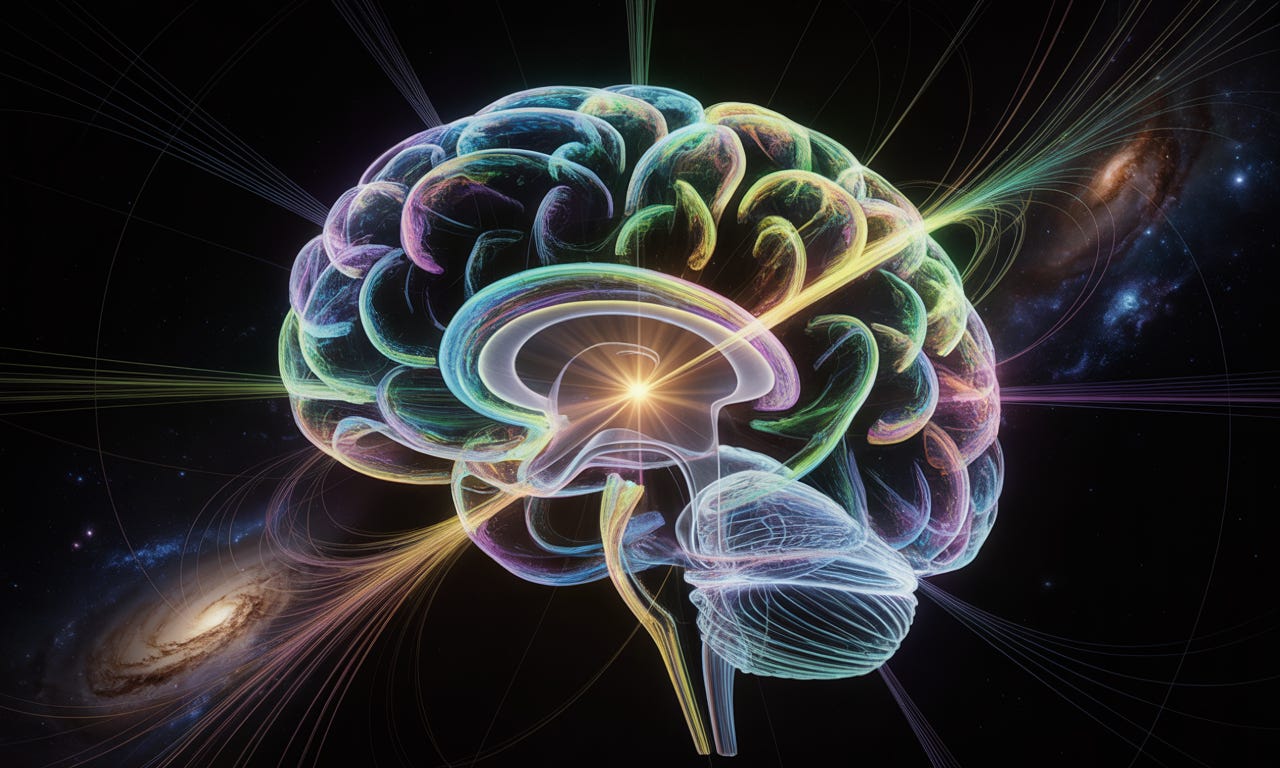
The Dome of the Brain
We speak of the mind in metaphors of space. The brain is a command center, thoughts occur to us, ideas light up neural pathways, but perhaps no metaphor is as revealing as the subconscious comparison we make between the skull and the dome. The cranium, that curved vault of bone, is our private Pantheon, its hemispherical shape a silent echo of the sacred architectures we’ve built for millennia. To call the brain a dome is not merely poetic; it is a recognition of how deeply our understanding of consciousness is intertwined with the geometries we inhabit.
Consider the language of introspection: we retreat into our minds, as if stepping into a quiet rotunda. When overwhelmed, we long for mental space, an expansion under the imagined curve of our inner ceiling. The dome’s function as a separator—sheltering the sacred from the profane, mirrors the skull’s role as a boundary between self and world. Just as ancient temples used domes to create zones of heightened focus, the brain’s physical enclosure fosters the illusion of a self-contained universe, where thoughts swirl like incense smoke beneath an oculus of attention.
Modern neuroscience inadvertently reinforces this metaphor. Brain imaging technologies like fMRI render the mind as a luminous, cavernous space, with activated regions glowing. The default mode network, the brain system responsible for self-reflection and daydreaming, lights up when we turn inward. Even the brain’s hemispheres, with their arched corpus callosum bridge, suggest a twin-domed structure, a bilateral sanctuary where meaning is negotiated between logic and intuition.
The comparison extends to dysfunction as well. Migraines are described as pressure inside the skull, as if the dome’s weight has become unbearable. Anxiety disorders speak of closed-in mental spaces, where the curvature feels stifling rather than expansive. Conversely, psychedelic experiences often report the sensation of the dome dissolving, a literal and figurative loss of ego boundaries, as if the oculus has widened to swallow the self whole. These subjective experiences reveal how instinctively we map the mind’s terrain using architectural terms, with the dome as its most primal blueprint.
The dome is not just a representation of the brain, it is its externalized twin, a projection of our neuroarchitecture into the physical world. When we stand beneath a great dome, we are not just experiencing a building; we are meeting a mirror. The curve above mirrors the curve within, and in that recognition, consciousness turns back on itself, awed by the symmetry. To build a dome is to sculpt a collective mind; to think beneath one is to remember that the self, too, is a kind of sacred space, a sanctuary of flickering neurons, lit by the variable sun of attention, waiting for the next beam of insight to strike.
The dome is more than an architectural form; it is a neurotheological interface. Its curves mirror the brain’s own hemispheric structure, its acoustics mimic the resonant chambers of the skull, and its play of light and shadow replicates the flickering patterns of neural activity. To stand beneath a dome is to stand inside a thought—a thought shaped by millennia of human intuition about the mind’s deepest workings.
Perhaps this is why domes persist across cultures, from Neolithic burial mounds to futuristic planetariums: they are externalized models of consciousness itself. When we build them, we are not just constructing shelters—we are sculpting mind-spaces, physical manifestations of the inner sanctums we retreat to when we close our eyes and dream. The dome is the brain’s echo in stone, and in that echo, we hear the whisper of something older than architecture: the shape of thought, given form.
Alloya- The Dome Effect