

The Descending Triangle
Spiritual Descent

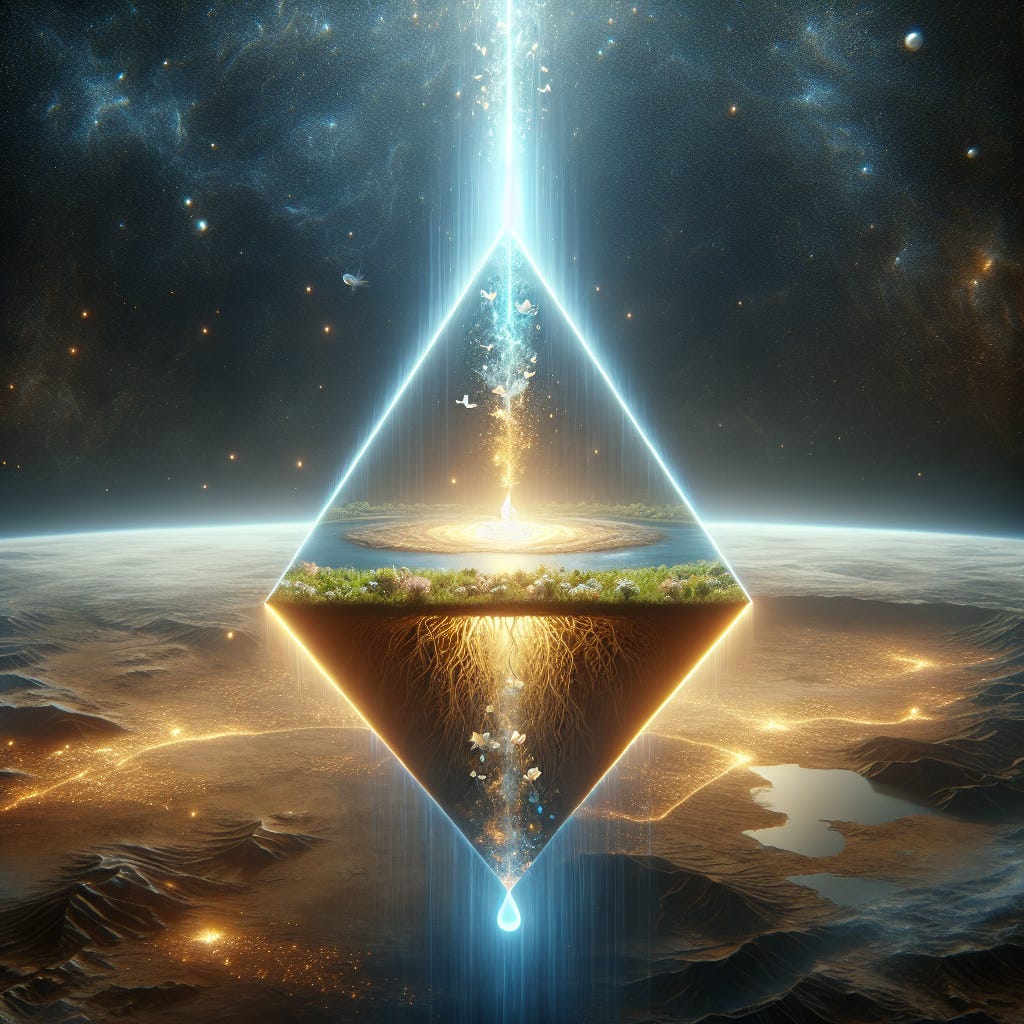
The upward-pointing triangle, with its apex reaching toward the heavens, speaks of aspiration, transcendence, and the soul’s yearning for divine reunion. But when the triangle inverts, its single point directed earthward, it embodies an equally profound principle, one of descent, grounding, and the sacred act of receiving. This downward orientation does not signify diminishment but rather the necessary complement to ascent, the feminine counterpart to the masculine thrust toward the infinite. Where the upward triangle is fire, the downward triangle is water; where one rises, the other flows; where one seeks, the other receives. Together, they form the complete cycle of spiritual energy, the eternal rhythm of emanation and return.
The descending triangle represents the principle of incarnation, the movement of spirit into form, the divine impulse made manifest in the material world. It is the vessel that holds, the womb that nurtures, the earth that grounds. In sacred geometry, this orientation is not passive but deeply active in its receptivity, a dynamic force that draws heavenly influences into tangible reality. Just as water naturally seeks the lowest point, carving channels through stone and nourishing all it touches, the downward-pointing triangle symbolizes the feminine energy that sustains life by anchoring the ethereal into the earthly. This is the energy of the Great Mother, the Shakti, the Sophia, the principle that makes the ineffable effable, the unseen seen, the abstract concrete.
In many wisdom traditions, the downward triangle is associated with the feminine archetype, not as subordinate to the masculine but as its essential complement. Where the upward triangle penetrates, the downward triangle receives; where one ascends, the other integrates. This is not a hierarchy but a dance, a sacred interplay that allows spirit to take root in matter without losing its connection to the source. The feminine principle, as embodied by the descending triangle, is the alchemical crucible in which divine potential is transformed into lived experience. It is the matrix of creation, the field in which seeds of consciousness grow into the forms of the world.
In Hindu tantra, the downward triangle (the Shakti Yantra) represents the creative power of the goddess, the dynamic force that brings the un-manifest into manifestation. In alchemy, it signifies the vessel of transformation, the container where base metals are transmuted into gold, a metaphor for the soul’s journey from fragmentation to wholeness. Even in modern depth psychology, the downward triangle echoes the concept of the unconscious, the fertile ground from which symbols, dreams, and archetypes emerge into conscious awareness.
This orientation also speaks to the principle of sacrifice, not in the sense of loss, but as a sacred exchange. Just as the earth receives the seed and gives back the harvest, the descending triangle teaches the wisdom of surrender, the art of allowing spirit to move through us rather than always striving to transcend our embodied condition.
The three points of the descending triangle, like those of its upward counterpart, correspond to foundational triads found across spiritual traditions. They may represent the three stages of manifestation, emergence, formation, and dissolution, or the three dimensions of time (past, present, future) held within the eternal now. In many cosmologies, the triangle bridges the three realms of existence: the celestial, the terrestrial, and the chthonic (the underworld or subconscious). The downward orientation emphasizes the movement from the celestial to the terrestrial, the process by which archetypal energies take shape in the middle world of human experience before descending further into the depths of the unseen.
This triadic structure reminds us that reality is not binary but inherently relational. Just as a triangle cannot exist with only two points, spiritual wholeness requires the integration of all three levels, the higher, the middle, and the lower. The descending triangle, in this sense, is an invitation to explore the sacredness of the below as much as the above, to honour the wisdom of the body and the earth as much as the aspirations of the soul.
In contemplative practice, the descending triangle serves as a focal point for grounding and embodiment. While the upward triangle directs attention toward transcendence, the downward triangle brings us back into the immediacy of the present moment, into the wisdom of the senses, into the intelligence of the body. It teaches that enlightenment is not an escape from the world but a deeper participation in it, a recognition that the divine is as much in the soil as in the stars.
This geometric form also offers a corrective to spiritual bypassing, the tendency to use transcendence as a way to avoid the challenges of embodied life. The downward triangle reminds us that true spirituality includes the full spectrum of existence, the light and the shadow, the joy and the grief, the ecstasy and the grit. It is the shape of incarnation, the geometry of a spirituality that does not flee the world but transforms it from within.
The descending triangle completes the circle of meaning begun by its upward counterpart. Together, they form a cosmology of wholeness, a map of the soul’s journey that includes both ascent and descent, both reaching and receiving. To focus only on one is to miss the fullness of the mystery, like trying to breathe in without breathing out, or to give without ever learning to receive.
The downward-pointing triangle is a testament to the sacredness of the earthly, the holiness of the here and now. It invites us to honour the feminine principle within and around us, to cultivate receptivity as a spiritual discipline, and to recognize that the divine is not only beyond us but also beneath us, within us, waiting to be embodied in every act of love, creativity, and grounded presence. In a world often obsessed with transcendence, the descending triangle offers a necessary wisdom: that true spirituality is not about escaping the world, but about blessing it with the light we have received from above.
The downward-pointing triangle is an ancient cipher for the elemental wisdom of water, the fluid intelligence that carves canyons, quenches thirst, and mirrors the sky while remaining rooted in the depths. Unlike fire’s upward leap, water’s power lies in its surrender to gravity, its willingness to fill the lowest places and, in doing so, become the lifeblood of the world. This is the essence of the inverted triangle: a sacred vessel, a chalice waiting to be filled. It speaks of the primordial womb from which all forms emerge and to which they return, the dark fertility of the Earth Goddess who receives the seeds of heaven and gives them body.
In the alchemy of the elements, the downward triangle is the sigil of water, not merely as H₂O but as a cosmic principle. Water dissolves boundaries, adapts without breaking, and reflects truth without distortion. The triangle’s descent mirrors this liquidity, this capacity to descend into the cracks of the world and soften what is rigid. It is the shape of rivers returning to the ocean, of rain sinking into soil, of tears carrying prayers to the unseen realms below. Where the upward triangle aspires, the downward triangle remembers, the ancestral wisdom held in bones, the silent knowing of stones, the patience of roots threading through darkness.
The Earth Goddess, in her myriad forms, Demeter, Gaia, Pachamama, Inanna descending to the underworld, wears this triangle as her mantle. It is her vulva and her throne, the cave where life is forged in darkness before emerging into light. To encounter the downward triangle is to stand at the threshold of her mysteries: that creation requires dissolution, that nourishment demands sacrifice, that every mountain must first be a valley. She is the grounding force that prevents spirituality from evaporating into abstraction.
Consider the way water honours the earth. It does not conquer or consume, but collaborates, filling hollows, wearing down resistance over epochs, singing the land into new shapes. The downward triangle teaches this same humility. In meditation, it becomes an anchor, a visual mantra for releasing mental chatter into the silence below the navel, the reservoir of primal energy. In ritual, it is traced to call upon the stabilizing forces of the underworld, the chthonic allies.
This is the paradox of the downward triangle: its descent is not a fall but a homecoming. To point earthward is to align with the magnetic pull of the sacred, the force that binds spirit to flesh. The Earth Goddess does not compete with the sky; she completes it. Her triangle is the cup that catches the elixir of moonlight, the bowl that holds the offering, the pelvis that cradles the unborn. Wherever we find the inverted triangle, in the delta of a river, in the sacred geometry of temples, in the iconography of goddesses holding overflowing urns, we are witnessing the same truth: that divinity is not only above, but below. Not only light, but dark. Not only spirit, but the body that makes spirit real.
Meditative Practice: Union of the Ascending & Descending Triangle
Preparation:
Sit comfortably with your spine straight, hands resting on your knees. Close your eyes and take three slow breaths, feeling your body settle into stillness. Imagine roots growing from your sitting bones into the earth, anchoring you.
Part 1: The Ascending Triangle (Fire, Aspiration, Spirit)
1. Visualize the Upward Light
In your mind’s eye, see a golden triangle pointing upward, its base steady at your heart and its apex rising infinitely toward the heavens. It glows like a flame—pure, bright, and alive with movement.
2. Breathe into Ascent
With each inhale, feel this triangle drawing energy upward from your core, through your spine, and out the crown of your head. Imagine it pulling you gently toward expansion—toward clarity, insight, and connection with the vastness above.
3. Mantra (silently or aloud):
"I rise, I awaken, I return to Source."
Repeat this three times, feeling the upward current lift your awareness beyond the body.
4. Rest in the Peak
Pause at the apex. Feel the stillness of pure being, where individuality dissolves into light. Stay here for three breaths, bathed in radiance.
Part 2: The Descending Triangle (Water, Grounding, Embodiment)
1. Shift to the Descent
Now, let the golden triangle invert, its point descending like a drop of water falling into a pool. It turns deep blue, its base now at your heart and its apex flowing down through your belly, legs, and into the earth.
2. Breathe into Embodiment
With each exhale, feel this triangle grounding you—cool, heavy, and nourishing. Imagine it carrying divine energy into your cells, your bones, the soil beneath you. You are not losing light; you are planting it.
3. Mantra (silently or aloud):
"I receive, I root, I become sacred earth."
Repeat this three times, sensing the downward current as a homecoming.
4. Rest in the Depths
Pause at the nadir. Feel the quiet wisdom of the dark—the stability of stone, the patience of roots. Stay here for three breaths, held by gravity.
Part 3: The Union (Star of Harmony)
1. Merge the Triangles
Let the upward (golden) and downward (blue) triangles overlap, forming a six-pointed star at your heart center. Watch them spin slowly, weaving fire and water, sky and earth.
2. Breathe the Circuit
Inhale: Light rises from earth to heavens.
Exhale: Blessing descends from heavens to earth.
You are the conduit—the meeting place.
3. Silent Integration
Rest here, breathing naturally. No effort, no words. Simply witness the balance of ascent and descent, giving and receiving.
Bring yourself back into the room when you feel intutively guided to do so.
Love Alloya