

The Atman
Beyond the Ego

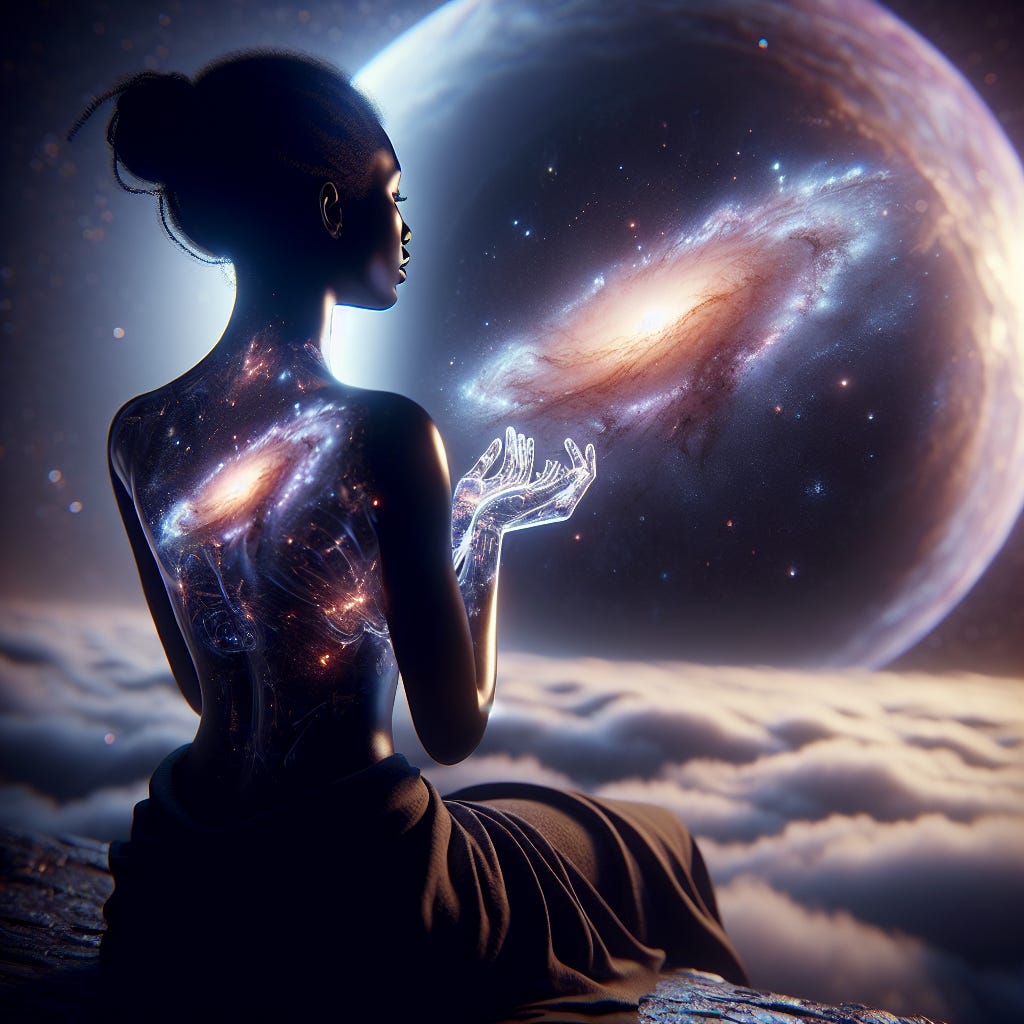
Before thought arises, before the first breath stirs the lungs, before the “I” can whisper its name, there is something already present. A silent knowing. A luminous stillness. A presence untouched by time or form. This is not the self we speak of in daily life, the ever-changing identity woven from memory, desire, and fear, but the unchanging witness behind all experience: the Atman.
Not born, not dying, not bound by body or mind, it is the very essence of awareness itself. To inquire into the nature of the Atman is not to study an abstract doctrine but to turn inward and meet the source of your own being, the infinite light in which all things arise, shine, and vanish like ripples on an eternal sea.
The Sanskrit term Ātman (आत्मन्) traces its origins to the ancient Proto-Indo-European root hehtmṓ, meaning breath, essence, or spirit—a linguistic ancestor shared by words like the Greek ἀτμός (atmos), evoking the subtle, life-giving air that surrounds us. This etymological lineage beautifully mirrors the profound philosophical essence of the Atman itself: the formless, eternal presence that breathes life into all beings, the silent witness behind every moment of awareness. It is not merely a soul or self in the conventional sense; it is the very pulse of consciousness, the inner light that illuminates thought, feeling, and perception.
In the sacred texts of the Upanishads, the Atman is revealed as more than just an individual soul; it is pure, undifferentiated consciousness, the unchanging, infinite Self that lies beyond the impermanent layers of body, mind, and ego. To confuse the Atman with the jīvātman, the embodied self caught in the wheel of birth, death, and rebirth (samsara), is to mistake the vast ocean for a single wave upon its surface. While the jīvātman dances within the illusion of time and form, shaped by karma and desire, the Atman remains untouched, immutable, a luminous spark of the Divine unblemished by the veils of maya, the cosmic illusion that obscures our true nature.
Unlike the Western notion of the soul often defined by personality, memory, or intellect, the Atman transcends all qualities and definitions. It is svaprakasha, self-luminous or self-shining consciousness needing no external source to reveal it. It cannot be grasped by thought or contained by language; rather, it is the very space in which all thoughts arise and dissolve, the stillness beneath the storm of experience. It is not an object of knowledge but the subject of all knowing—the “I” behind the “I am.”
To realise the Atman is to awaken from the dream of duality, to pierce through the veil of ignorance (avidya) that creates the illusion of separateness. True liberation (moksha) is not something to be earned or achieved; it is a remembrance, a return to the original state of unity that was never truly lost. It is the recognition that you have always been the Atman, limitless, free, and one with the boundless light of Being.
To awaken to the Atman is not to reach toward some distant, hidden truth but to see clearly what has always been present, closer than thought, breath, or sensation. It is to recognise that the sense of separation we so often feel the belief in being a limited, isolated self, is a veil woven by the mind a mistaken identity imposed upon the infinite. In this light, the world of names and forms, of time and space, does not vanish but it is seen for what it truly is: a play upon the screen of consciousness, arising and dissolving in the ever-present now. Just as a wave may momentarily imagine itself separate from the ocean, so too does the ego believe itself apart from the Self. But the moment this illusion is seen through, the longing ceases, the seeking ends, and one rests in the natural state of being, vast, silent, and whole.
The Atman is characterised by its eternal, imperishable, and timeless nature, unchanging amidst the ceaseless flux of the manifest world. It is not something that comes into being or passes away with the death of the body; rather, it is the very ground of all being, untouched by birth, decay, or dissolution. Like the sun that remains unaffected by the shadows it illuminates, the Atman remains unstained by the joys and sorrows, virtues and vices, triumphs and failures of life. It is nitya (eternal), śuddha (pure), bodha (consciousness itself), and mukta (ever-free), qualities not as attributes, but as pointers to its essential nature beyond all limitation.
It is consistently described in the wisdom of the Upanishads as the ever-free, never-bound, innermost radiant Self, the core of one’s true identity beneath the layers of conditioned thought and worldly identification. This is not the small self shaped by circumstance, culture, or psychology but the vast, impersonal consciousness that witnesses all states of waking, dreaming and deep sleep without ever being touched by them. The ego may tremble with fear or swell with pride, the mind may chase after pleasure or recoil from pain, but the Atman remains unmoved and uninvolved, like the sky untouched by the birds that fly through it.
Entirely unaffected by personality or ego, the Atman is not a possession of the individual, nor does it change according to one’s beliefs, desires, or spiritual attainments. It simply IS, the luminous presence behind every moment of awareness, the silent stillness within every storm of experience. To realise the Atman is not to become something new but to remove the veils of ignorance (avidya) that obscure our natural inheritance: the knowledge that we are not limited beings struggling toward freedom but freedom itself, momentarily dreaming of limitation.
This rrealisationthe direct knowing that “I am That”, is considered in the Vedic tradition to be the ultimate purpose of life, the highest meaning one can uncover and the final liberation (moksha). It is not a salvation earned through devotion or ritual, nor a reward granted by divine decree but the awakening to one’s own intrinsic nature as pure consciousness, infinite and indivisible. In this recognition all seeking ends, all suffering dissolves and the soul rests at last in the peace of its own true home.
”Just as the rivers flowing east and west merge in the sea and become one with it, forgetting they were ever separate rivers, so all creatures lose their separateness when they merge into pure Being. There is nothing that does not come from it. Of everything it is the inmost Self. It is the Truth; it is the Self. And you are that, Shvetaketu.”- Chandogya Upanishad

The metaphor of rivers merging into the sea losing their individual identities to become one with the boundless ocean is among the most profound in the Upanishads. It illustrates not just the dissolution of the ego but the revelation of an eternal truth: the Atman is not a separate entity to be discovered but the very ground of being in which all apparent separation arises and subsides.
The Atman cannot be captured in the nets of language, nor confined within the walls of thought. It slips through the fingers of definition like water, shimmering just beyond the grasp of the intellect. The sages knowing this spoke in the language of negation—neti neti, “not this, not this”, peeling away layer after layer of illusion, not to define what the Atman is but to dissolve all that it is not.
It is nirguna without attributes, a boundless expanse of being untouched by the fleeting storms of pleasure and pain, virtue and vice. The personal soul, the jīvātman wanders through the labyrinth of karma, collecting scars and stories believing itself to be the actor in its own drama. But the Atman? It is the untouched sky behind the clouds, the silent canvas upon which all colours appear and fade. It does not rejoice in virtue nor cower in sin, it simply is luminous and untethered, like a flame that burns without fuel.
It is nitya, eternal not in the way a mountain seems eternal to a mayfly, but in the way light is inseparable from the sun. It was never born, and so it cannot die. Birth and death are but costumes slipped on and off by the body, fleeting shadows cast upon the screen of existence. The Atman watches unmoved, the way the moon watches a thousand waves rise and fall without ever being swept into the sea. It does not age, it does not decay, it is the timeless presence behind the ticking of the clock, the stillness at the heart of all motion.
It is akarta the non-doer. The hands move, the mind churns, the tongue speaks and the world rushes on in its ceaseless dance of cause and effect. Yet the Atman does not act. It is pure awareness, the unmoved witness like a mirror that reflects without clinging without judging. The body may hunger, the heart may ache, the mind may weave dreams and fears but the Atman remains untouched, like the depths of the ocean undisturbed by the tempest on its surface.
And it is asanga, unattached, utterly free, as space is free, holding galaxies within itself yet remaining weightless, boundless, unstained. The world arises within it like a mirage in the desert, vivid yet insubstantial. Pleasure cannot bind it, pain cannot scar it, desire cannot ensnare it. It is the untouched center around which the wheel of existence turns, the silent axis of the spinning world.
The Atman is not found in scriptures, nor in rituals, nor in the fervent prayers of the seeker. It is found in the hush between thoughts, in the space between breaths, in the moment when the seeker vanishes and only the sought remains. It is the answer to every question, the silence beneath every cry, the light by which all shadows are known.
And yet, here is the great paradox—it is you. Not the “you” that worries and hopes, not the “you” that remembers and forgets, but the “you” that has never come into being and will never pass away. The “I” before “I am.” The knower behind all knowing. The Self of all selves.
In the grand architecture of Vedic thought the Atman is inseparable from Brahman—the ultimate, unconditioned reality that underlies, pervades and transcends the entire universe. The famous declaration Tat Tvam Asi—”That Thou Art”—is not a poetic metaphor, nor a symbolic statement of unity. It is a direct pointing to the non-dual truth: the Self within you is none other than the Self of the cosmos. The innermost essence is not different from the infinite substratum of all existence. They are one, just as the space inside a jar is not different from the space outside it, until the jar breaks, revealing the boundless air beyond.
To truly understand this is to dissolve the illusion of separation at its root. It is not that the Atman merges into Brahman like a drop into the ocean, it is that the drop was never separate. It was always ocean. The notion of individuality arises only when consciousness identifies with form, with name and shape, with memory and desire. But the Atman untouched by these fluctuations remains ever free.
The great sage Adi Shankaracharya, in his commentary on the Upanishads likened the relationship between Atman and Brahman to the reflection of the sun in water. The reflection appears real, even moving, shimmering with life but it is not the sun itself. So too does the ego imagine itself to be a doer, a thinker, a sufferer, while the true Self merely witnesses all activity without involvement. When the waters calm, the reflection dissolves and only the sun remains.
And so, the seeker must ask: Who is it that seeks liberation? Who is it that meditates, practices, yearns for realisation? Is it the ego, still clinging to the idea of attainment? Or is it the quiet recognition that freedom was never absent, that the Atman has never been veiled except by the belief that it needs to be found?
This is the final subtlety of the path, not effort but surrender; not searching but seeing. Not chasing after stillness but recognising that you are already the silence in which all movement occurs. Even now, as thoughts arise and pass, as sensations ripple through the body, as emotions swell and recede, there is something watching untouched. That witness is not apart from you. It is you. It is the Atman.
It is not far away. It is not hidden in some distant temple or secret teaching. It is the very presence in which all things appear. You do not need to become anything else to realise it. You need only stop identifying with what you are not. To say the Atman cannot be known is not to say it is unknowable. It is simply that it cannot be known as an object, for it is the subject of all knowing. It is not seen because it is the seer. It is not heard because it is the hearer. It is not thought because it is the thinker. It is not loved because it is love itself.
So how can one approach it?
Not by reaching out, but by letting go.
Not by accumulating knowledge, but by peeling away false identifications.
Not by seeking but by resting in the natural state of pure being.
Meditation to Realise the Atman: The Ocean of Pure Awareness
Preparation:
Sit in a quiet space, spine erect yet relaxed, hands resting gently on the knees or lap. Close your eyes. Let the breath flow naturally, neither forcing nor restraining it. Allow the body to settle like a still mountain unmoved by the winds of thought.
1. Dissolving the Layers of Illusion (Neti Neti – “Not This, Not This”)
Begin by gently withdrawing awareness from the external world.
- ”I am not the body.”
Feel the weight of the physical form, the sensation of sitting, the touch of air on skin and then recognise: *These are experienced, but I am the experiencer. The body changes, grows old, yet I remain. I am not the body.
- ”I am not the emotions.”
Notice any feelings—joy, sorrow, restlessness arising like waves. Observe them without attachment. Emotions come and go; they are fleeting weather in the sky of awareness. I am not the emotions.
- ”I am not the mind.”
Thoughts drift like clouds. Watch them pass without grasping. The mind is a river of impressions, but I am the silent space in which it flows. I am not the mind.
Now, rest in the stillness that remains.
2. Turning Inward: The Flame of Awareness
Shift attention to the sense of “I”—the feeling of being present, alive, aware.
- Ask: ”Who is aware?”
Do not answer with words. Instead feel back like tracing a beam of light to its source.
- Behind the thoughts, behind the sense of “me,” there is a luminous presence—the silent witness. It does not speak yet it knows. It does not move, yet it is alive.
- Rest here, as the watcher of all watching, the knower of all knowing.
3. The Atman as Infinite Space (Akasha)
Imagine the body dissolving into vast, boundless space—no edges, no center, just pure openness.
- ”I am not in the world; the world is in me.”
The body, the room, the earth—all arise within this expanse of awareness like dreams appearing in consciousness.
- ”I am not a drop in the ocean; the ocean is in me.”
The Atman is not a small, separate self but the boundless sea in which all waves of existence rise and fall.
- Rest as this infinite presence.
4. The Merging: Rivers into the Ocean
Recall the Upanishadic wisdom:
- Feel all sense of individuality dissolving—no seeker, no meditation only pure being.
- Let go of even the thought “I am the Atman,” for the Atman is beyond all concepts.
- Be what remains: silence, light, boundless freedom.
5. Returning (Without Ever Having Left)
When ready, gently bring awareness back to the body and breath.
- Recognise: The Atman was never absent, it is here now, as it always has been. It is the very fabric of this moment.
- Carry this knowing into daily life: The world move, but I am still. Forms change but I am unchanging.
This meditation is not an exercise to achieve the Atman but a gentle unravelling of all that obscures it. The Atman is already here, your true nature, shining effortlessly. Like the sun behind clouds, it does not need to be created only recognised.
Practice daily, not as a seeker but as the Self remembering itself.
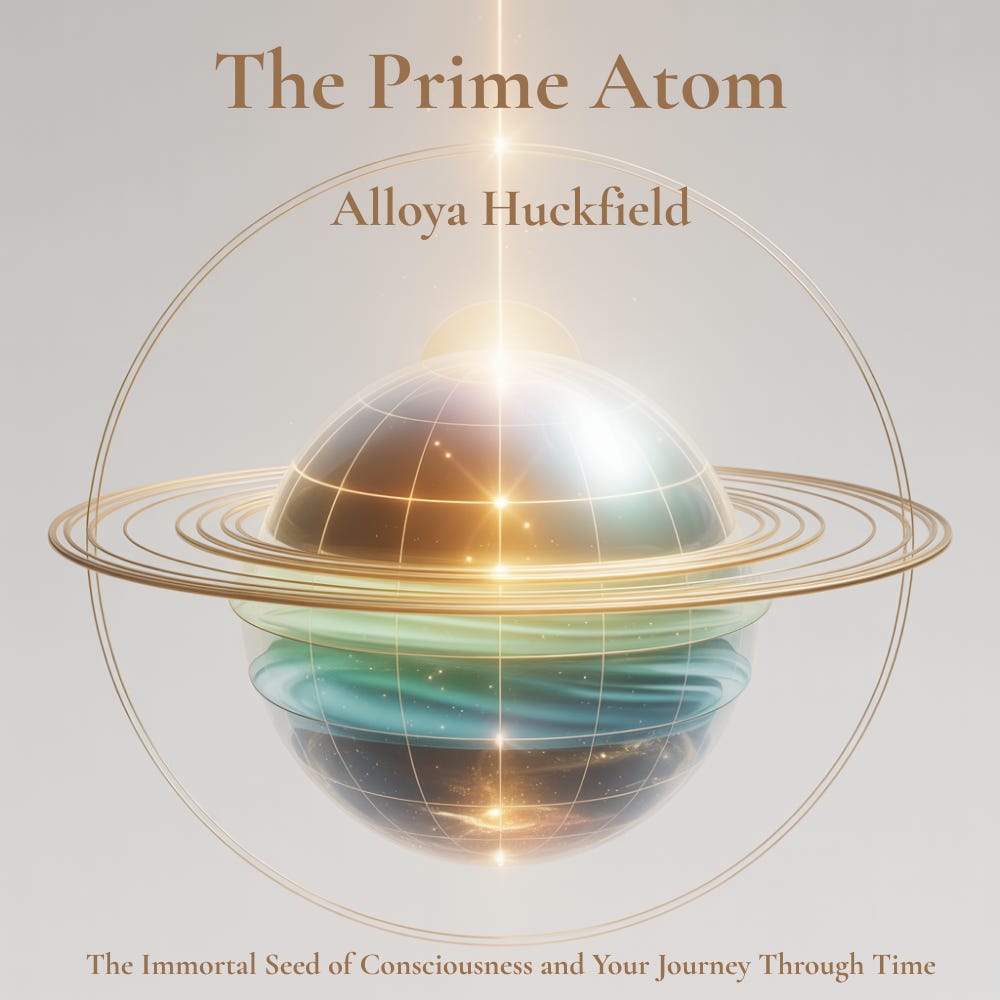
We live in a world of constant change, yet within each of us lies an indestructible core, a divine, eternal essence that transcends birth, death, and time itself. This is the Prime Atom: the immortal nucleus of consciousness that records every experience, shapes every destiny, and holds the sacred blueprint of your soul’s journey.
In this ground-breaking book, you will explore the hidden science of the soul as preserved in ancient mystery schools and esoteric traditions. This is not philosophy or speculation; it is a detailed map of your multidimensional being, revealing the precise mechanics behind reincarnation, karma, and spiritual evolution.
Inside, You Will Discover:
The Architecture of the Self: Understand the threefold nature of your being, Personality, Soul, and Spirit and how they interact across multiple planes of existence.
The Prime Atom Unveiled: Learn how this eternal seed within you records every thought, emotion, and action, not as memory, but as vibrational imprints that shape your future lives.
The Science of Karma & Rebirth: Discover how the law of cause and effect operates through permanent atoms, and how you can consciously transmute your destiny.
The Process of Spiritual Alchemy: Follow the journey from unconscious incarnation to enlightened liberation, including the role of chakras, meditation, and soul-guided living.
The Ultimate Transition: Explore the advanced stages of initiation where identity shifts from the soul to the monad, and the Prime Atom itself is transcended in cosmic unity.
Whether you are a seasoned student of the occult or new to spiritual wisdom, this book offers a transformative understanding of your eternal nature. It is a guide to realising that you are not a passive passenger in life, but a conscious co-creator of your destiny.