

Rudolf Steiner
Cosmology of the Human Soul

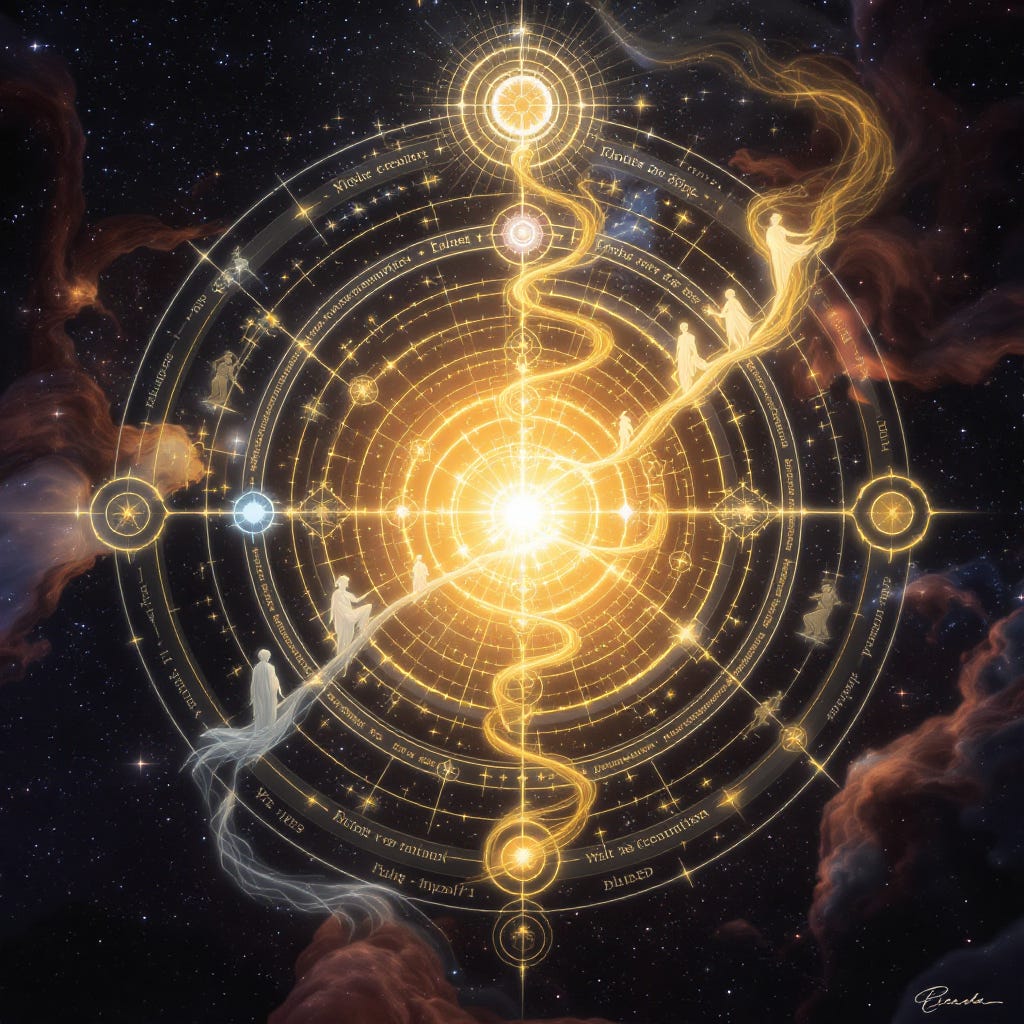
Rudolf Steiner, the Austrian philosopher, scientist, and spiritual researcher who founded anthroposophy in the early twentieth century, considered the circle not as a mere illustration but a living schema, a map of the soul’s journey through time, matter, and consciousness. It was through this circular model that he sought to reveal the deeper rhythm of human evolution, the dynamic interplay between spirit and matter, and the eternal pilgrimage of the soul through incarnations. In Steiner’s vision, the circle becomes more than a shape; it becomes a cosmology, a psychology, and a spiritual compass.
Steiner’s approach to understanding the human being was fundamentally different from the linear, mechanistic models dominant in his time. He rejected the idea that consciousness evolves in a straight line, progressing from ignorance to knowledge, from childhood to maturity, from instinct to intellect. Instead, he proposed a spiral model of development, where growth is not a one-way street but a perpetual return, a cyclical unfolding. The soul, in this view, does not simply advance; it recapitulates, revisits, and transforms. Each life is not an isolated event, but a chapter in a vast, unfolding story. The circle, therefore, is not static. It is alive, dynamic, and recursive. As Steiner often emphasized, true understanding comes not from dissecting phenomena into isolated parts, but from seeing them in their full context, within the living web of interrelated forces that stretch across the visible and invisible realms.
At the heart of Steiner’s cosmology lies the concept of the human being as a multi-layered entity, existing simultaneously in several planes of reality. These planes are not metaphysical abstractions, but actual dimensions of being that the soul traverses in its journey. The physical world, the realm of tangible matter, is the outermost rim of the circle. Here, the human being is embodied, shaped by gravity, time, and the laws of nature. This is the world of sensation, of touch, of visible form. Yet, Steiner insisted, this physical existence is only one aspect of who we are. Beneath the surface of matter lies a deeper layer, the etheric realm, which he described as the life-force or vital principle that sustains the body. This is the world of growth, of metabolism, of the subtle energies that animate living things. It is not visible to the ordinary eye, yet it is palpable in the pulse of life, in the rhythm of breathing, in the healing power of sunlight on the skin. In Steiner’s diagrams, this is represented as an inner concentric circle, closer to the center, where the soul begins to emerge.
Further inward lies the astral realm, the world of soul, feeling, and desire. This is where emotions, imagination, and memory reside. It is the realm of inner experience, the domain of dreams, of artistic inspiration, and of the deep currents of human longing. Here, the soul is not yet self-aware, but it is active, striving, feeling. It is in this sphere that the soul begins to form its identity, to develop character, to respond to the world with love, fear, joy, and sorrow. The astral realm is not a passive background, but a dynamic field where the soul shapes itself through experience. It is here that the seeds of moral choice are sown, where the individual begins to differentiate between right and wrong, not from abstract rules, but from the inner resonance of feeling.

And at the very center of the circle, pointed, focused, yet infinitely expansive, is the spiritual ego, the “I” that Steiner considered the core of human individuality. This is not the ego of psychology, the inflated self-image of the modern ego, but the true, spiritual “I” that arises through the disciplined cultivation of self-awareness. It is the part of us that can say, “I am,” not as a mere assertion, but as a living reality of inner certainty. The spiritual ego is the seat of freedom, of moral responsibility, and of conscious will. It is the point from which the soul can look out upon the world and say, “This is mine to shape.” In Steiner’s view, this ego is not born in the first life, but slowly developed through countless incarnations. It is the product of repeated cycles of experience, of suffering, of learning, of transformation. The ego is not something we possess from birth; it is something we earn.
This circular structure, the physical at the rim, the etheric, the astral, and the spiritual ego at the center, does not represent a hierarchy in the sense of superiority, but rather a depth of reality. Each layer is essential, each contributes to the wholeness of the human being. The physical body is the vessel, the etheric form the life-force, the astral the soul, and the spiritual ego the conscious self. But what makes this model truly transformative is not just its structure, but its movement. The circle is not fixed. It is in motion. It is not a static diagram, but a living process. This process is what Steiner called the rhythm of incarnation and excarnation , the soul’s descent into matter and its return to spirit.
To understand this rhythm, one must step beyond the common notion of death as an end. In Steiner’s view, death is not a final separation, but a transition, a release from the physical form, a return to the spiritual worlds where the soul processes its experiences. After death, the soul does not vanish. It ascends, not to a heaven in the clouds, but to the astral and spiritual realms, where it reflects upon the life just lived. It reviews the choices made, the relationships formed, the lessons learned. It feels the consequences of actions not as punishment, but as wisdom. It sees how fear distorted perception, how love opened the heart, how selfishness closed the door to deeper connection. This period of reflection is essential. It is the soul’s opportunity to integrate the experiences of the physical life, to distill them into spiritual understanding. It is during this phase that the soul begins to form its next incarnation, not randomly, but with purpose. It chooses the circumstances, the parents, the challenges, the opportunities for growth that will help it evolve.
And so, the circle turns again. The soul descends once more, drawn by the need to experience new forms of life, to confront old patterns, to break through old limitations. It enters the physical world again, taking on a new body, a new set of conditions, a new set of challenges. But it is not the same soul. It is a soul that has learned. It carries within it the memory of past lives, not as recollections, but as subtle imprints in the etheric and astral bodies. These imprints shape temperament, inclinations, and even certain talents. A person with a strong inclination toward music may have had a past life where they expressed themselves through song. Someone drawn to healing may have served as a physician in a former existence. These are not mere coincidences, but echoes of spiritual development.
What makes this process so profound is its rhythm. Each incarnation is not a new beginning, but a continuation. The soul returns to the same general themes, love, conflict, creativity, suffering, but each time at a higher level of consciousness. The same challenges are faced, but with greater awareness. The same mistakes are made, but with the intention to learn. This is the spiral of evolution: not a straight line, but a turning path that rises upward while circling back. The soul does not escape the cycle; it masters it. It becomes less bound by the past, more free in the present, more conscious in the future.
Steiner often used the metaphor of the spiral to illustrate this process. Imagine a spiral staircase winding upward. Each turn is a life, a cycle of incarnation. But as the staircase ascends, each turn is higher than the one before. The soul, with each return, carries more light, more clarity, more self-awareness. It is not simply repeating the same patterns, but transforming them. The fear that once paralyzed is now recognized as a signal of growth. The pain that once seemed meaningless becomes a teacher. The relationships that once caused conflict become opportunities for understanding. The soul learns to see itself in others, to feel the suffering of the world not as a burden, but as a call to compassion.
This understanding of the soul’s journey is deeply psychological, yet it is also spiritual. Steiner did not separate the inner life of the individual from the larger cosmos. He believed that the evolution of the soul is mirrored in the evolution of humanity as a whole. Just as the individual soul progresses through cycles of incarnation, so too does humanity move through great epochs of spiritual development. These epochs are not arbitrary divisions, but real stages in the unfolding of consciousness. In Steiner’s view, humanity has passed through three main epochs: the Saturn, Sun, and Moon epochs, each corresponding to a different stage of spiritual evolution.
In the Saturn epoch, humanity was not yet individualized. Souls existed in a collective, dreamlike state, not bound by physical form. The world was still dominated by the spiritual forces of the past, and human beings were more like spiritual entities than physical ones. Then came the Sun epoch, when the soul began to take on individual form. The human being became distinct, self-aware, capable of independent thought and action. This was the time of ancient wisdom, of myth, of the great religious traditions. Then came the Moon epoch, which Steiner associated with the development of the human ego—the “I” consciousness. This is the epoch in which we currently live, where self-awareness, rationality, and individuality have reached their peak. But Steiner warned that this stage is not the end. It is a threshold.
The next epoch, which he called the “Earth” or “Christ” epoch, is one of spiritual rebirth. In this era, the individual soul is no longer defined by ego alone, but by a deeper, more inclusive consciousness. The ego is not abolished, but transformed. It becomes a servant of the soul, not its master. The human being begins to experience unity with others, with nature, and with the divine. The circle of incarnation is still present, but the soul is no longer trapped in endless repetition. It is moving toward a state of conscious, voluntary reincarnation, not out of necessity, but out of love. The soul chooses to return, not to escape suffering, but to serve. It becomes a conscious participant in the evolution of the world.
This vision is not fantasy. Steiner believed that such a transformation is possible through spiritual training, through the development of inner clarity, moral discipline, and intuitive perception. He taught that every human being has the potential to awaken the spiritual ego, to become aware of the soul’s journey, and to take responsibility for its own evolution. This is not a passive process. It requires effort. It requires meditation, ethical living, artistic expression, and the cultivation of inner stillness. The circle, in this sense, is not just a model of fate, but a call to action. It is a reminder that our lives are not isolated moments, but part of a greater rhythm. Each choice we make, each moment of attention, each act of kindness, is a step along the spiral. Each life is a chapter in a story that is still being written.
The circle also holds profound psychological significance, as Carl Jung later explored in his studies of the mandala. Jung observed that in times of inner crisis or psychological transformation, individuals often spontaneously create circular images, mandalas, whether in dreams, drawings, or meditative states. These images, he noted, are not random. They are archetypal, arising from the collective unconscious. They represent the self, the unified whole, the integration of opposites. Jung saw the mandala as a symbol of psychological wholeness, a reflection of the soul’s desire to return to its center. Steiner would have agreed. For him, the circle was not just a symbol of wholeness, but the very structure of soul development. The soul, in its journey, is constantly seeking to return to its center, the spiritual ego. It is drawn to harmony, to balance, to the point where all contradictions are resolved.
In this light, the circle becomes a guide for daily life. When we feel scattered, overwhelmed, disconnected, we can turn inward and ask: What is my center? What is the core of my being? Where is my soul located within the layers of thought, emotion, and sensation? The answer is not found in the outer rim, the physical world of distractions and demands, but in the center, where the spiritual ego resides. It is in this center that we find clarity, peace, and purpose. It is from this center that we can make choices not out of fear or habit, but out of conscious will. It is from this center that we can see the interconnectedness of all things, the physical, the etheric, the astral, the spiritual.
Steiner taught that the circle is not just a personal journey, but a collective one. The evolution of humanity is not the sum of individual souls, but the result of their mutual interaction. Each soul, in its incarnation, contributes to the collective spiritual atmosphere. The love we give, the compassion we show, the truth we speak, all ripple outward, shaping the world. The circle, in this sense, is not only within us, but around us. It is the pattern of life itself, the rhythm of birth, growth, decay, and renewal. It is the cycle of the seasons, the turning of the earth, the pulse of the heart. It is the heartbeat of the cosmos.
In a world that often celebrates speed, progress, and linear advancement, Steiner’s circle offers a radical alternative. It invites us to slow down, to look inward, to recognize that growth is not always forward, but often inward. It teaches that true evolution is not about escaping the world, but about transforming it from within. It reminds us that every life, no matter how small or seemingly insignificant, is part of a greater whole. That every experience, every pain, every joy, is a step on the spiral of soul development.
Ultimately, the circle is a symbol of hope. It is the promise that we are not lost. That we are not alone. That our journey, though long and sometimes difficult, is meaningful. That every return to the physical world is not a fall, but a descent into service. That every death is not an end, but a return to the source. That every soul, no matter how burdened or broken, carries within it the potential for light. And that, in the center of the circle, there is a point of pure being, the spiritual ego, the I, the self that is eternal.
To live with the circle in mind is to live with awareness. To walk through the world not as a passive observer, but as a conscious participant. To see each encounter as a soul’s opportunity, each challenge as a chance to grow, each moment as a sacred return to the center. It is to understand that the soul is not something we acquire, but something we become. And that becoming is not a straight path, but a spiral, ever turning, ever rising, ever returning to the same place, yet always different, always more whole.
In the end, the circle teaches us that the soul is not separate from the world, but is woven into its very fabric. That matter and spirit are not opposites, but different expressions of the same reality. That the physical body is not a prison, but a temple. That the soul, in its journey, is not lost in time, but is always present, always evolving, always becoming. And that, within each of us, there is a center, a spiritual ego, that has been waiting, patiently, for us to remember it. To return. To become. To complete the circle.
Love Alloya