

Plato's Triangular Soul
Plato's Triangular Soul

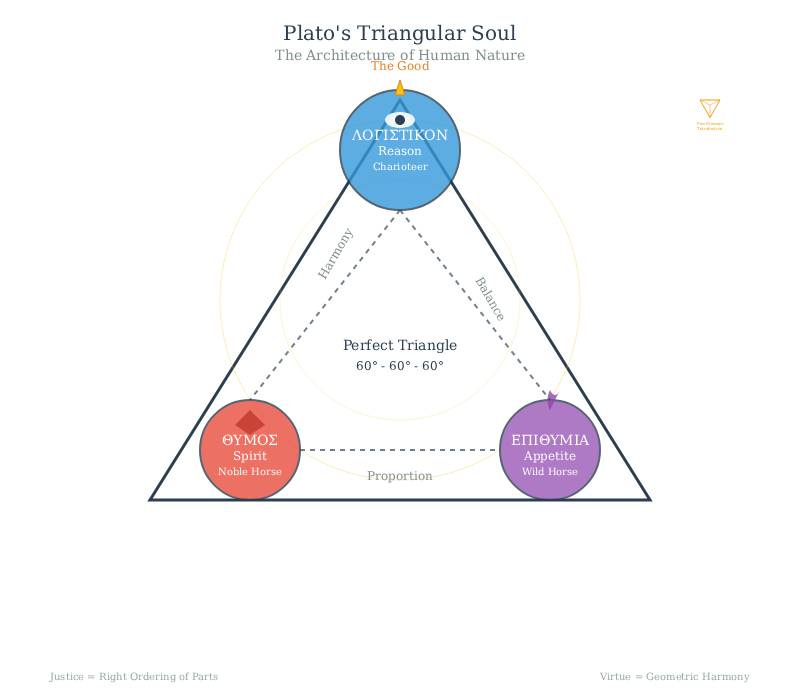
In Western philosophy, few thinkers have woven together metaphysics, ethics, and mathematics as seamlessly as Plato. His dialogues are not merely philosophical treatises but poetic, geometric, and deeply symbolic explorations of the human condition. Among the most enduring and profound of his insights is the tripartite theory of the soul, articulated with particular clarity in *Phaedrus* and *Republic*. At first glance, this division of the soul into reason, spirit, and appetite appears as a psychological model, a way to understand the internal conflicts that shape human behaviour. But when examined through the lens of Platonic metaphysics and cosmology, especially as developed in the *Timaeus*, this tripartite soul reveals itself not just as a moral framework, but as a mathematical structure: a triangle. The soul, in Plato’s vision, is not only divided into three parts, but structured *as* a triangle, an ideal geometric form that reflects the very architecture of reality.
Plato’s tripartite soul consists of *logistikon*, the rational principle; *thymos*, the spirited or emotional faculty; and *epithymia*, the appetitive or desiring part. These are not mere psychological categories but ontological forces, each with its own nature, origin, and function. In the *Republic*, Plato uses the metaphor of a chariot to illustrate their interaction: reason is the charioteer, guiding two horses, one noble and disciplined (spirit), the other unruly and wild (appetite). The success of the journey, toward truth, virtue, and the Good, depends on the harmonious coordination of all three. But beyond the metaphor lies a deeper, more formal structure: the triangle. The soul, when properly ordered, assumes the shape of a triangle, with *logistikon* at the apex, elevated above and governing the two lower faculties. This is not an arbitrary image. The triangle, in Platonic thought, is far more than a simple geometric figure. It is the first closed shape, the minimal enclosure of space, the primordial form through which unity becomes multiplicity. It is, in essence, the geometry of differentiation.
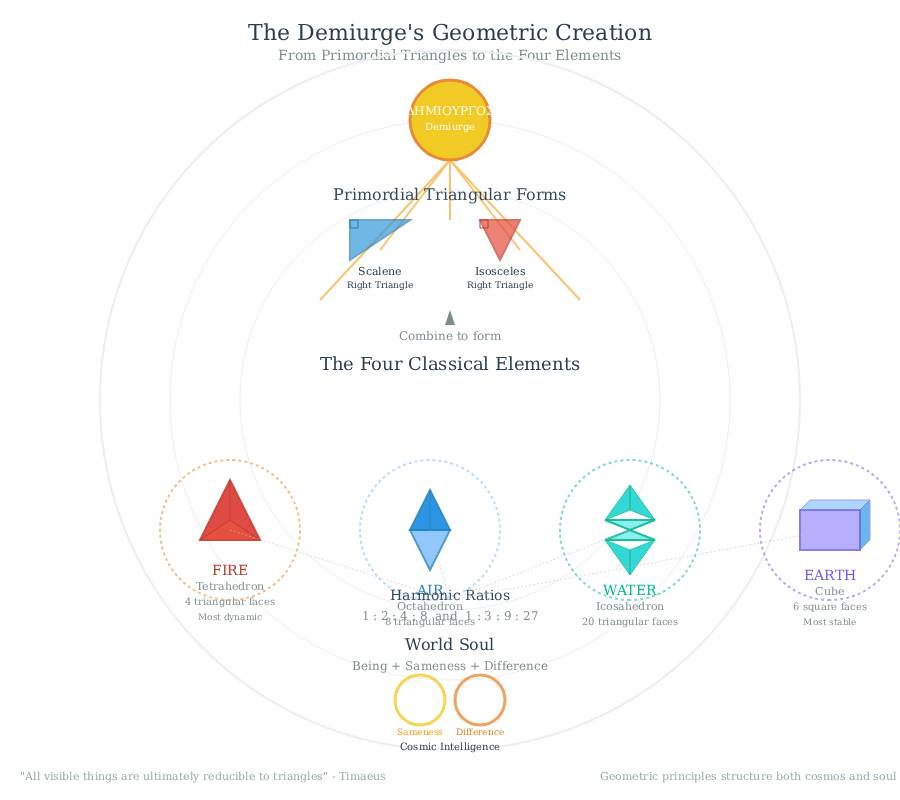
To understand why the triangle is so central to Plato’s conception of the soul, one must first appreciate his broader metaphysical framework. For Plato, the visible world is a shadow or imitation of a higher, intelligible realm of Forms, eternal, unchanging, and perfect archetypes. Among these Forms, mathematical objects hold a privileged place. Numbers, circles, and especially triangles are not merely tools for calculation but real, ontological structures that underlie all of reality. In the *Timaeus*, Plato’s most cosmological dialogue, the Demiurge, the divine craftsman, constructs the physical world using geometric principles. He begins with the four classical elements, earth, air, fire, and water and assigns each a specific polyhedral shape: the cube for earth, the octahedron for air, the icosahedron for water, and the tetrahedron for fire. Notably, the tetrahedron, the simplest of the Platonic solids, is composed entirely of equilateral triangles. Fire, the most dynamic and transformative of the elements, is thus built from the most fundamental geometric unit. This is no accident. For Plato, fire is not just a physical phenomenon but a symbol of divine energy, illumination, and spiritual ascent. Its geometric basis in the triangle suggests that the triangle itself is a carrier of spiritual significance.
But the connection between the triangle and the soul goes deeper than elemental symbolism. In the *Timaeus*, Plato describes the creation of the World Soul, a cosmic intelligence that animates and orders the universe. This soul is not made of matter but of a more refined substance: a mixture of Being, Sameness, and Difference. These three principles are blended in precise mathematical ratios, forming a kind of harmonic scale that structures time, motion, and the heavens. The Demiurge divides this mixture into strips, which are then bent into two interlocking circles: one representing sameness (the circular motion of the fixed stars), and the other representing difference (the planetary motions). Yet, beneath this circular imagery lies a hidden triangular logic. The blending of Being, Sameness, and Difference is not arbitrary; it is a triadic structure that mirrors the tripartite soul. Moreover, the ratios used in the construction of the World Soul—such as the double and triple intervals (1:2, 2:4, 3:6, etc.), are rooted in the arithmetic and harmonic means, which themselves can be visualized geometrically through triangles.
The triangle, then, is not merely a shape but a principle of organization. It is the minimal structure capable of holding tension, balance, and direction. In the human soul, this structure manifests as the dynamic equilibrium between reason, spirit, and desire. When these three parts are in harmony, the soul functions as an equilateral triangle: all sides equal, all angles balanced, all forces in proportion. This is the ideal state, the just soul. In the *Republic*, Plato argues that justice in the individual is not the absence of conflict but the right ordering of the soul’s parts. Reason, possessing knowledge of the Good, must rule; spirit, aligned with honour and courage, must support reason; and appetite, the seat of bodily needs and pleasures, must be governed. When this hierarchy is maintained, the soul is not only morally upright but mathematically perfect. It is a soul in which the ratios are correct, the proportions harmonious, and the form stable.
This idea of the soul as a mathematical harmony echoes Pythagorean influences, which were deeply embedded in Plato’s thought. The Pythagoreans believed that the cosmos was governed by number and that the soul itself was a kind of harmony, a tuning of internal ratios. Plato adapts this idea but gives it a distinctly ethical and psychological dimension. For him, the soul’s harmony is not merely a metaphysical given but an achievement. Most people, he suggests, live with disordered souls, souls shaped like scalene or isosceles triangles, where one part dominates to the detriment of the others. The tyrannical soul, for example, is ruled by appetite, with reason weakened and spirit corrupted. This soul is lopsided, unstable, and prone to collapse. The timocratic soul, driven by honour and victory, elevates spirit above reason, creating another kind of imbalance. Only the philosopher-king, who has cultivated reason through dialectic and contemplation of the Forms, possesses a soul that approximates the equilateral ideal.
The triangle, as a geometric form, thus becomes a symbol of both structure and aspiration. It represents the soul’s potential for unity through differentiation. Just as a single point, when divided and extended, becomes three points that enclose a space, so too does the soul emerge from unity into a triadic structure. This process mirrors the Platonic account of creation: the One (the Good) differentiates into Being, Sameness, and Difference, which then give rise to the World Soul and, by extension, all individual souls. The triangle is the first manifestation of multiplicity within unity, a paradoxical form that is both simple and complex, static and dynamic. It is closed, yet it points upward. It is bounded, yet it suggests transcendence.

This upward orientation is crucial. In the tripartite soul, *logistikon* occupies the apex, not merely as a position of dominance but as a direction of movement. Reason does not just control the lower parts; it orients the soul toward the divine. The triangle, with its upward-pointing vertex, becomes a symbol of spiritual ascent. In this sense, the soul is not only structured like a triangle but *moves* like one, striving toward the summit, the One, the Good. This is why Plato associates philosophy with geometry: both are forms of ascent, of turning the soul from the shadows of the cave to the light of the sun. The study of mathematics, particularly geometry, purifies the soul by training it to see not with the eyes but with the mind. When one contemplates an equilateral triangle, one is not merely observing a shape but participating in an eternal truth. One is aligning the soul with the intelligible realm.
The connection between the soul and the triangle is further reinforced by Plato’s theory of recollection (*anamnesis*). In dialogues like the *Meno*, Plato argues that learning is not the acquisition of new information but the recollection of knowledge the soul already possesses from its pre-natal existence in the realm of the Forms. The famous scene in which Socrates guides a slave boy to “discover” a geometric truth, the doubling of the square, illustrates this point. The boy does not learn from Socrates; he remembers. His soul, though embodied, still carries the imprint of eternal truths. Among these truths are mathematical forms, including the triangle. The fact that the soul can recognize the properties of a triangle, its angles, its proportions, its symmetry, suggests that such forms are not external to it but constitutive of its very nature. The soul, in other words, is geometric by essence.
This idea gains even greater depth when we consider the role of the triangle in Platonic cosmology. The Demiurge, in constructing the universe, uses triangles as the building blocks of matter. All visible things are ultimately reducible to right-angled triangles, specifically, the “scalene” and “isosceles” right triangles, which are combined to form the faces of the Platonic solids. These triangles are not physical objects but ideal templates, the invisible scaffolding of material reality. Everything that exists, bodies, colours, textures, is a manifestation of underlying geometric ratios. But if the physical world is constructed from triangles, and the soul is also structured as a triangle, then there is a deep resonance between the microcosm and the macrocosm. The human soul is a reflection of the cosmic order. Its triangular form is not a metaphor but a participation in the same geometric principles that shape the stars and the elements.
This participation is not passive. The soul, unlike inert matter, has the capacity for self-correction and transformation. It can, through philosophy and moral discipline, reconfigure itself into a more perfect triangle. This is the essence of Platonic education: not the filling of a vessel but the turning of the soul. The philosopher is one who recognizes the soul’s geometric nature and seeks to align it with the ideal. This alignment is both ethical and mathematical. To be just is to have a soul in which the parts are in the right proportion. To be wise is to perceive the ratios that govern reality. In this sense, virtue is a kind of geometry, the art of balancing the soul’s forces according to eternal measures.
Love Alloya