

Plato's Triangular Foundation
The Timaeus

Fewer minds in human history have so profoundly redefined our understanding of reality, knowledge, and the architecture of existence as Plato, the Athenian philosopher who founded the Academy, the first institution of higher learning in the Western world. A devoted student of Socrates and mentor to Aristotle, Plato’s dialogues, especially “The Republic and the Timaeus”, laid the intellectual bedrock for Western philosophy, science, and metaphysics. In these works, he wove together ethics, epistemology, and cosmology into a unified vision of a rational, ordered universe governed by eternal truths.
Nowhere is this vision more vividly realized than in the Timaeus, a dialogue that stands as Plato’s most ambitious attempt to explain the origin, structure, and purpose of the cosmos. Here, Plato presents a cosmology rooted in mathematical perfection, where the universe is not the product of chance or chaos, but the deliberate creation of a benevolent Demiurge, a divine craftsman who shapes the material world by modelling it after the immutable Forms, the perfect archetypes existing in the realm of pure intellect. This act of creation is not arbitrary; it is an expression of nous (divine reason), which imposes harmony, proportion, and geometric precision upon primordial disorder.
At the very heart of this cosmic design lies a deceptively simple figure: the triangle. For Plato, the triangle is far more than a shape in Euclidean geometry, it is the primordial unit of physical reality, the irreducible atom of form and substance. He asserts that all visible bodies are composed of surfaces, and all surfaces can be decomposed into triangles. Thus, the triangle becomes the foundational element from which the entire material world is constructed.
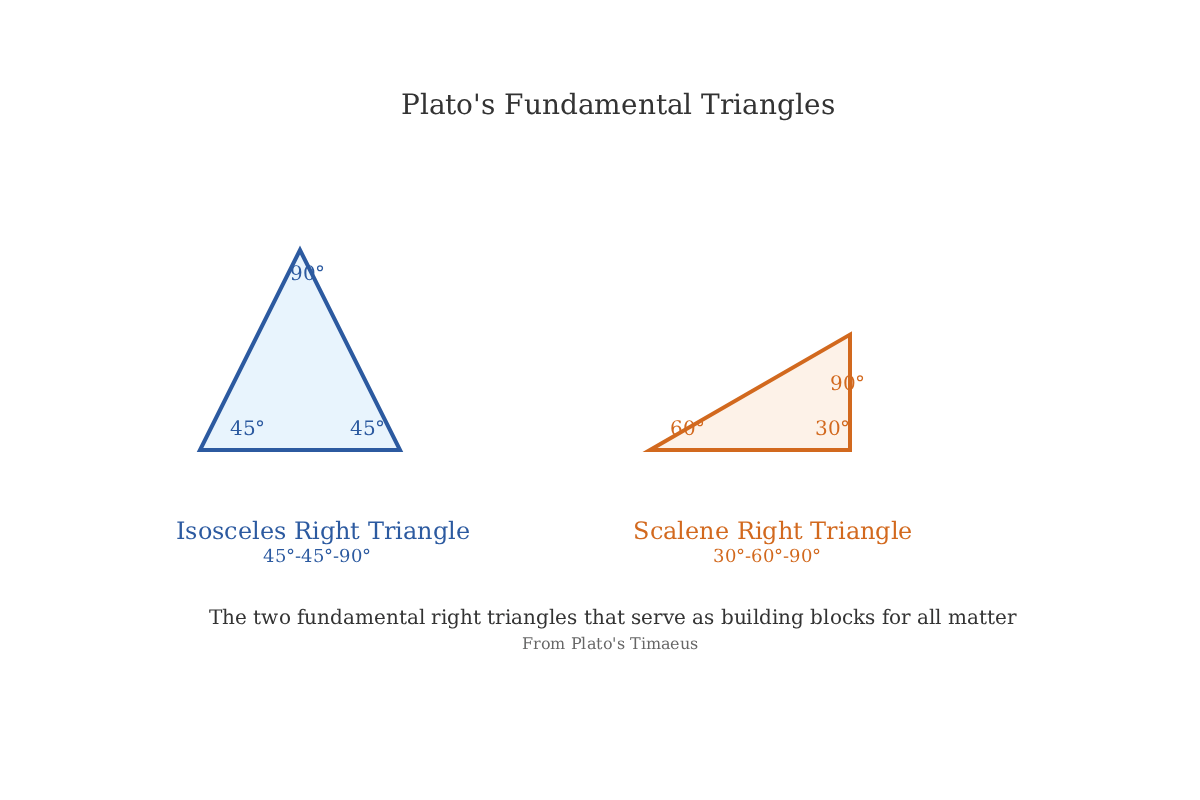
Plato identifies two fundamental types of right triangles as the building blocks of all matter: the isosceles right triangle (45°-45°-90°) and the scalene right triangle (30°-60°-90°). From these, he derives the faces of the five regular polyhedra, now known as the Platonic solids, each associated with one of the classical elements. These solids are not merely symbolic; they are, for Plato, the actual geometric forms that constitute the particles of fire, air, water, earth, and the cosmos itself.
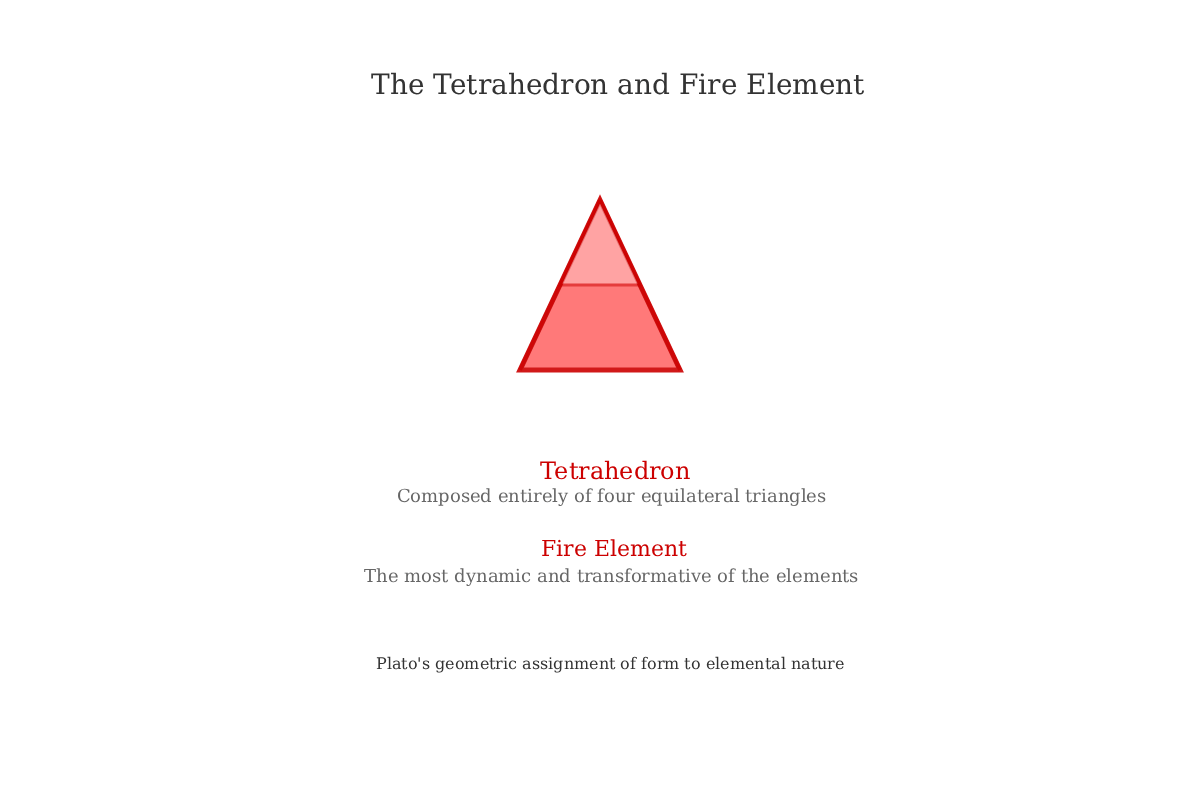
Of these, the tetrahedron, composed entirely of four equilateral triangles, is assigned to fire, the most dynamic and transformative of the elements. Each equilateral triangle, in turn, is constructed from six scalene right triangles, revealing a deeper layer of geometric reduction. The sharp vertices, minimal volume, and high mobility of the tetrahedron mirror the essential qualities of fire: its piercing heat, its upward motion, its capacity to illuminate and transform. In Plato’s view, this is not metaphor or analogy; it is ontological truth. Fire is the tetrahedron, because its essence, its behaviour, its nature, its very being, is perfectly expressed in this geometric form.
But the significance of the triangle extends beyond mere physical composition. It embodies a principle of transformation and ascent. The triangle’s pointed apex, reaching toward the heavens, symbolizes the soul’s orientation toward the divine, toward the realm of the Forms. Fire, as the lightest and most ethereal element, represents the soul’s yearning for enlightenment, for unity with the intelligible world. Thus, the triangle becomes not only a structural component but a spiritual symbol, a geometric expression of the soul’s journey from the darkness of ignorance to the radiance of truth.

This metaphysical depth is what elevates Plato’s use of geometry beyond proto-science into the realm of sacred philosophy. The Demiurge does not invent these forms; he discerns and imitates them from the eternal realm of the Forms. Geometry, therefore, is not a human invention but a discovery of pre-existing perfection. The triangle, as an abstract, unchanging entity, participates in the world of Forms. When it is used to structure matter, it acts as a bridge between the eternal and the temporal, the divine and the material.
The triangle reflects Plato’s core epistemological belief: that true knowledge is not derived from the senses, which perceive only flux and illusion, but from reason and mathematical insight, which access the stable, unchanging truths behind appearances. In the Timaeus, the universe is knowable precisely because it is mathematical at its core. The triangle, as the simplest polygon capable of enclosing space, becomes the key to unlocking nature’s hidden order. By reducing the complexity of the physical world to a few ideal triangles, Plato reveals a cosmos that is not only rational but beautiful, a reflection of divine intelligence and moral goodness.
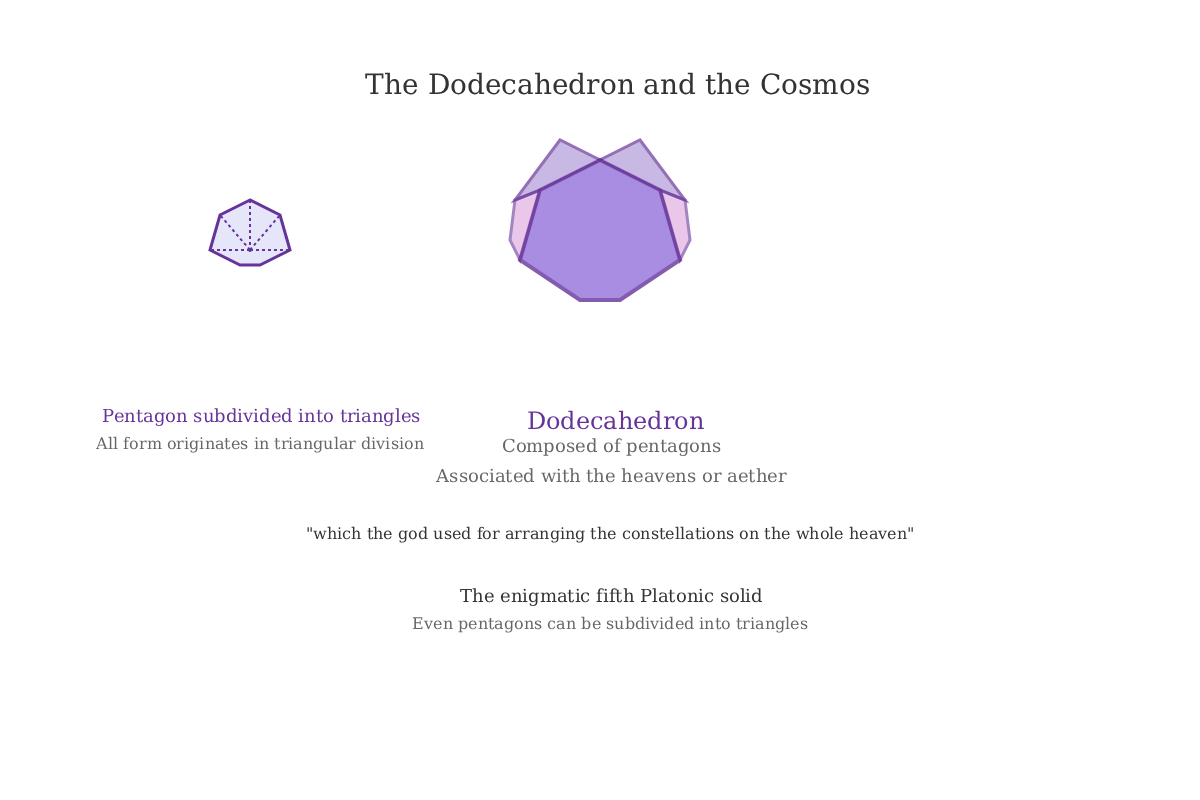
Among the five Platonic solids, the dodecahedron, composed of pentagons and associated with the heavens or aether, remains enigmatic, “which the god used for arranging the constellations on the whole heaven,” as Plato cryptically notes. Yet even here, the triangle plays an indirect role, as pentagons can be subdivided into triangles, reinforcing the idea that all form originates in triangular division.
In this grand vision, the triangle transcends its role as a mere geometric figure. It becomes a cosmic archetype, the instrument through which the formless receives structure, through which stillness gives rise to motion, and through which the unity of the One differentiates into the multiplicity of the Many. It is the first act of creation made visible, the point at which divine reason touches matter and begins to shape it.
Thus, in the Timaeus, Plato offers more than a theory of matter, he offers a philosophy of reality where mathematics is not just a tool for description, but the language of creation itself. Through the triangle, he reveals a universe imbued with order, purpose, and beauty a cosmos where geometry is sacred, where form is truth, and where the soul, guided by reason, can ascend from the shadows of the cave to the luminous realm of eternal Forms. In this way, the triangle is not only the foundation of the physical world but also a symbol of the human mind’s capacity to grasp the divine. For Plato, to study geometry is to participate in the work of the Demiurge, to align oneself with the rational structure of the cosmos and, ultimately, to approach the nature of the Good itself.
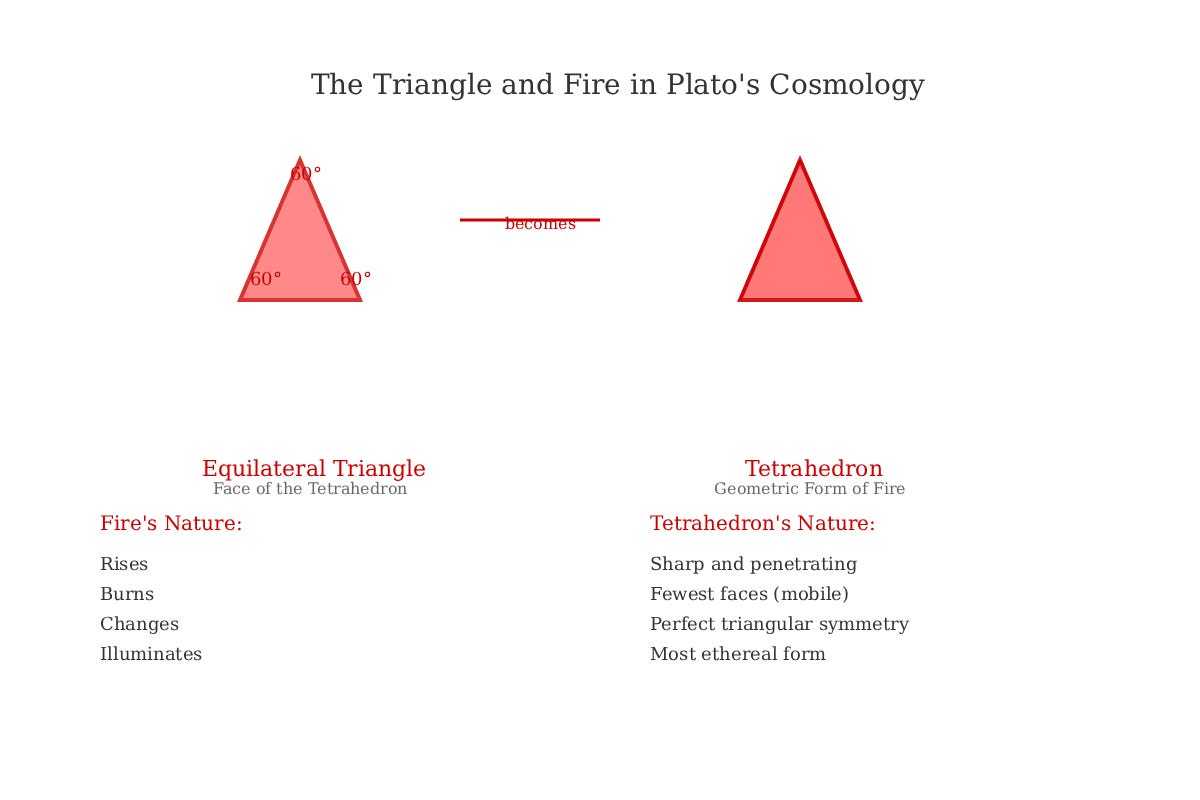
Plato’s choice of the tetrahedron to represent fire is deliberate and deeply symbolic. In the Timaeus, he writes:
“The sharpest and smallest particles… move with the greatest ease and speed, and their motion produces the sensation of heat. Of all the bodies formed by nature, that which is composed of the smallest and most pointed particles is fire.”
— Timaeus, 58c
This passage reveals that for Plato, the physical properties of fire, its sharpness, its heat, its rapid motion, are directly linked to the geometric form of its constituent particles. The tetrahedron, with its four triangular faces, four vertices, and six edges, is the simplest and most angular of the Platonic solids. Its vertices are acutely pointed, capable of piercing the surrounding medium, just as flame penetrates darkness. Its minimal volume relative to its surface area makes it the most mobile and least stable of the elemental forms, perfectly suited to embody the restless, upward-striving nature of fire.
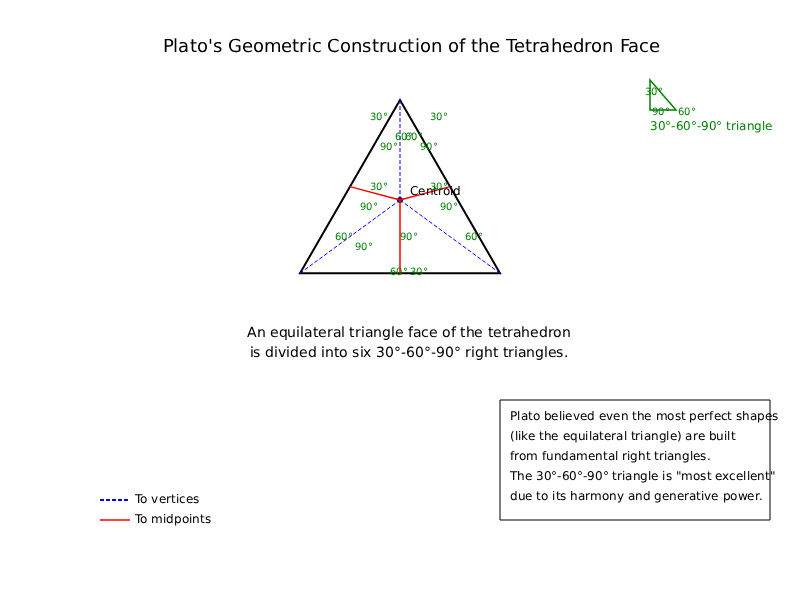
Each face of the tetrahedron is an equilateral triangle, which Plato constructs from six scalene right triangles (30°-60°-90°), derived from the division of an equilateral triangle into three parts from its center. This subdivision reveals a deeper layer of geometric order: even the most perfect shapes are built from more fundamental right triangles, which Plato calls the “most excellent” of all triangles due to their mathematical harmony and generative power.
“There are two kinds of right-angled triangles: one with one right angle and two equal acute angles, isosceles; the other with unequal acute angles-scalene. From these, the elements are constructed.”
— Timaeus, 54a
It is the scalene right triangle, not the isosceles, that gives rise to fire. This distinction is crucial. The isosceles triangle, with its symmetry and balance, forms the cube of earth, the most stable and immovable element. But the scalene, with its asymmetry and dynamic proportions, generates the more fluid and energetic elements: fire, air, and water. Fire, being the most active, is built from the most mobile and penetrating of these triangles.
Plato further explains that the particles of fire can transform into those of air, and air into water, through the disassembly and recombination of these triangular components. When fire (tetrahedron) interacts with water (icosahedron), for example, it may break down into its constituent triangles and reassemble into the form of air (octahedron). This process is not random but governed by geometric necessity:
“When they change into one another, they are dissolved into triangles, and then recombined into new forms.”
— Timaeus, 56c
Thus, the triangle becomes the indestructible unit of change, the invariant core beneath all transformation. Matter, in Plato’s view, is not conserved in the modern chemical sense, but geometry is. The triangle persists through all elemental metamorphoses, serving as the constant substrate of physical reality.
This idea elevates the triangle from a passive building block to an active principle of energy and motion. Fire, as the embodiment of the tetrahedron, is not just a substance but a force of initiation and illumination. It is the spark that awakens the inert, the light that reveals what was hidden, the heat that drives change. In this sense, fire is analogous to nous, divine reason, because both are agents of order, both impose form on chaos.
Indeed, Plato’s cosmology suggests a deep correspondence between fire and consciousness. Just as fire rises naturally upward, so too does the soul strive toward the intelligible realm. The triangle, with its apex pointing skyward, becomes a natural symbol of this ascent. Its three sides may also evoke the tripartite structure of the soul, reason, spirit, and appetite, or the three dimensions of space, or even the triadic structure of being, becoming, and becoming-perfect, as later Neoplatonists would elaborate.
Fire, as the element most closely associated with light, is linked to truth and knowledge. In the Republic, Plato compares the Good to the sun, whose light enables sight just as the Form of the Good enables understanding. Fire, as the source of artificial light, extends this metaphor, it is the human attempt to replicate divine illumination. And since fire’s essence is geometrically defined by the triangle, the pursuit of knowledge becomes a kind of geometric contemplation, a return to the first principles from which all reality unfolds.
In this light, the study of geometry is not merely academic, it is spiritual discipline. To trace the lines of a triangle is to participate in the Demiurge’s act of ordering chaos. To understand the properties of the equilateral triangle is to glimpse the mind of God. As Plato is said to have inscribed above the entrance to his Academy:
“Let no one ignorant of geometry enter here.”
This famous phrase underscores the centrality of mathematics in Platonic philosophy. Geometry is the path to truth because it trains the soul to see beyond appearances to the eternal Forms. When we look at fire through Plato’s eyes, we do not see mere flame, we see a living geometry, a dynamic interplay of triangles in motion, a physical manifestation of divine rationality. Fire is not random combustion; it is structured energy, shaped by mathematical necessity, guided by cosmic purpose.
The triangle, as form, brings order to matter. Fire, as energy, brings movement to stasis. Together, they symbolize the soul’s journey from the cave of ignorance to the light of the Good, a journey that begins with a single point, extends into a line, unfolds into a triangle, and culminates in the vision of the One.
As Proclus, the later Neoplatonist commentator on Plato, would write:
“The triangle is the first shape to show forth the power of the Monad; it is the beginning of all form, the seed of all structure.”
And so, in the quiet geometry of three lines, Plato saw the spark of creation itself, the divine fire that shapes the cosmos, and the inner flame that guides the philosopher home.
Love Alloya