

Euclid's Theorem
47th Proposition of Euclid

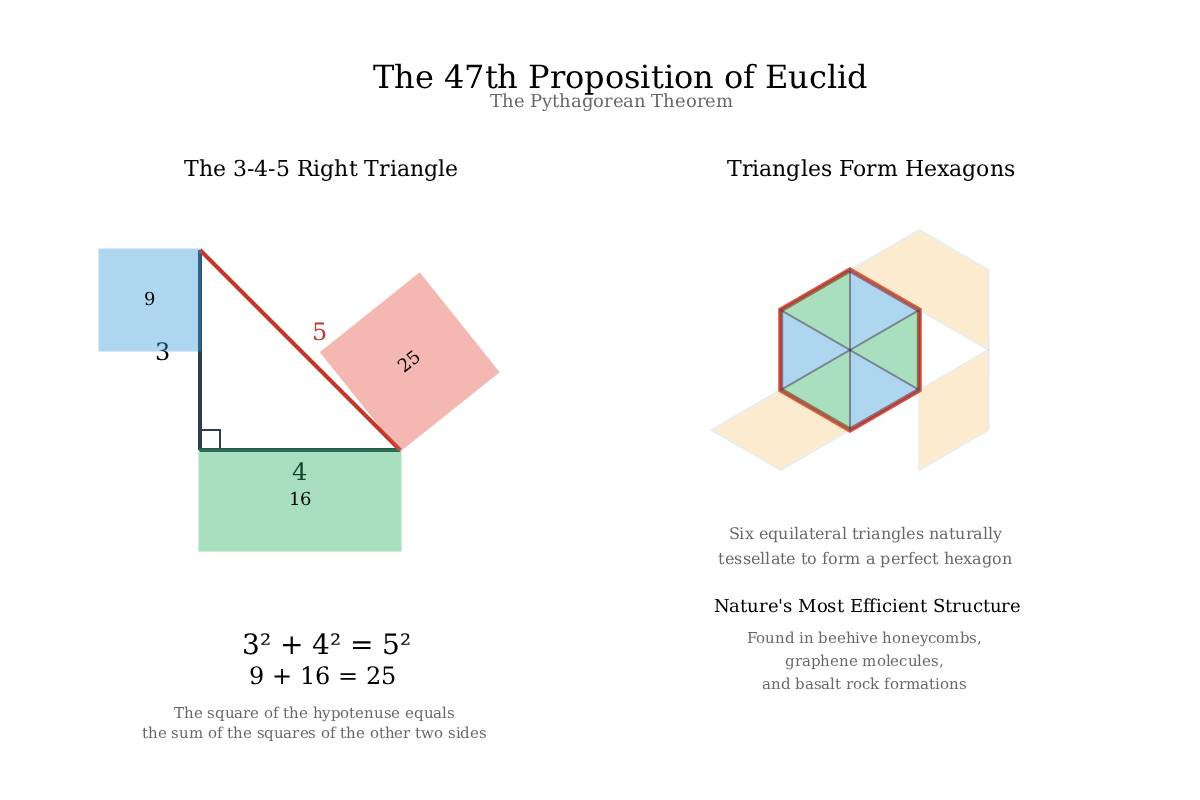
The profound and enduring legacy of the 47th Proposition of Euclid, commonly known as the Pythagorean theorem, stands as a testament to the human capacity to discern eternal truths from the fabric of the observable world and to then elevate those truths into symbols of immense philosophical and spiritual significance. This mathematical principle, which definitively states that in a right-angled triangle the square of the hypotenuse is always and without exception equal to the sum of the squares of the other two sides, represents far more than a simple rule for geometric calculation. It is a fundamental law of spatial relationship, a cornerstone of rational thought that bridges the chasm between the abstract realm of number and the tangible reality of form.
Its discovery marked a pivotal moment in human history, where the universe was revealed to be not a capricious realm of chaos but a cosmos, an ordered system governed by principles that could be understood quantified and relied upon. The most elementary whole-number expression of this theorem, the 3-4-5 triangle, provides the clearest window into its initial practical application. For the ancient builders of Egypt, Mesopotamia and beyond, this specific proportional relationship was not an academic curiosity but the very foundation of their sacred and civic architecture. In an era devoid of modern precision instruments, the ability to generate a perfect right angle was the most critical step in constructing stable walls aligning vast structures with celestial bodies or cardinal directions and ensuring the geometric integrity of a temple or pyramid.
By taking a cord and marking it into twelve equal segments, they could create a loop with knots at the positions that would define a triangle of three, four and five units. When stretched taut, this cord would irresistibly form a perfect right angle, a physical manifestation of an abstract mathematical law. This act of “squaring the foundation” was, in its essence a ritual of imposing cosmic order onto the raw materials of the earth. It demonstrated a seamless synthesis of intellect and craft, proving that the mind could apprehend universal principles and the hands could employ them to create enduring monuments. The pyramid, the most iconic symbol of ancient construction stands as a monumental tribute to this understanding, its perfect square base and triangular faces a grand-scale embodiment of the geometric principles accessible through the contemplation of the humble right triangle.
The journey of the 47th Proposition from a master builder’s practical secret to a central tenet of Western esoteric thought illustrates the human propensity to find deeper, allegorical meaning in natural law. In traditions such as Freemasonry, which drew heavily on the symbolism and practices of operative stonemasons, the theorem was stripped of its purely utilitarian function and reinvested with profound spiritual significance. It became a central symbol, often referred to with reverence, representing the quintessential idea of harmonious balance between opposing forces and the emergence of a third, transcendent reality from their perfect integration. Within this rich symbolic framework, the two shorter sides of the right triangle are interpreted as representing the fundamental dualities that permeate all of existence. These dualities can be understood as spirit and matter, active and passive, light and darkness, the masculine and feminine principles, or even the conscious and subconscious mind. Left to themselves these forces can exist in a state of conflict or imbalance, leading to instability, chaos or stagnation. The true genius of the 47th Proposition however lies in its demonstration that these opposites are not meant for eternal strife but are designed to enter into a specific, lawful and proportional relationship. The hypotenuse, the longest side is therefore not merely a mathematical result; it is the symbolic product of this harmony. It is the path of equilibrium, the stable and transformative outcome that could not exist without the cooperative interaction of the two generating principles. It represents the integrated self, the stable society or the coherent cosmos that arises when dualities are reconciled according to an eternal and verifiable formula.
For the Freemason, the theorem is presented as a moral and spiritual compass. It teaches the initiate that the goal of life is not to allow one aspect of one’s nature to dominate another but to build the inner temple of one’s character by bringing all opposing elements into a just and balanced relationship. The square, the tool used to test the right angle, becomes an emblem of morality and virtue and the theorem itself provides the immutable law that ensures the square is true. Thus, the 47th Proposition evolves from a geometric rule into a dynamic metaphor for the entire process of spiritual creation and personal rectitude, asserting that a life well-lived is one built upon the same unwavering principles of balance and proportion that underpin the stability of the physical universe.

This conceptual use of the triangle as a mediator and an organizing principle extends into a broader metaphysical paradigm that serves as a foundational model for understanding the layered nature of reality itself. A vast number of spiritual and philosophical systems, from the esoteric traditions of the West to the ancient wisdom of the East, describe the cosmos as manifesting through three fundamental planes or levels of being. These are most commonly categorised as the spiritual plane, the mental or psychic plane and the physical plane. A crucial and often overlooked aspect of this model is that these three planes are not conceived as separate locations, like distinct worlds stacked one atop the other but rather as different densities, vibrations or frequencies of a single unified reality. Their relationship is perfectly and elegantly encapsulated by the geometry of a single triangle. The three points are distinct, each possessing its own unique qualities and characteristics yet they are intrinsically connected and it is their collective relationship that defines a single, unified shape.
The spiritual plane corresponds to the realm of pure potentiality, unity and ultimate cause. It is the world of the divine, the archetypal, the world of being. It is undifferentiated consciousness, the source from which all manifestation ultimately springs. The mental or psychic plane acts as the crucial intermediary, the world of thought, imagination, form and individual consciousness. Here, the pure, undifferentiated potential of the spiritual plane begins to coalesce into specific patterns, blueprints and ideas. It is the realm of the Logos, the formative world where the designs for creation are drawn. The physical plane is the world of material manifestation, the final stage of condensation where energy and idea take on the forms that can be perceived by the five senses. It is the world of effect, the most dense and limited expression of the underlying reality, yet it is utterly dependent upon and permeated by the two subtler planes above it.
This triangular model is not a static, hierarchical chart but a dynamic and interactive map for understanding the flow of energy, consciousness and causation. It provides a coherent framework for conceptualizing the process of emanation or involution, whereby divine energy descends from the subtle, causal level of the spiritual plane through the formative and structuring level of the mental plane and into the dense, concrete manifestation of the physical plane. This is often described as a process of increasing limitation or veiling, where the infinite potential of the source gradually takes on the constraints of specific form and law. Conversely, and of paramount importance for the spiritual seeker, the triangle provides an equally clear chart for the path of return, the evolution or ascent of consciousness. Through dedicated spiritual disciplines such as meditation, contemplation, selfless service and the rigorous application of ethical principles, an individual learns to refine their awareness. They learn to shift their primary identification from the dense, ephemeral physical body and the material world of effects, to the more subtle and powerful realities of the mental and spiritual aspects of their being. The triangle thus becomes a navigational guide for this profound inner journey. It illustrates that spiritual evolution is not a matter of acquiring something new from outside but of awakening to the deeper levels of one’s own existence, of consciously ascending through the planes of which one is already a composite being.
It is a symbol that simultaneously describes the macrocosm, the structure and emanation of the universe from a unitary source into multiplicity and the microcosm, the structure and potential of the human being. The great work of spiritual alchemy is the work of making the microcosm a perfect reflection of the macrocosm and the triangle serves as the blueprint for both. It demonstrates that the path to enlightenment is one of transcending limitations and ascending through the levels of one’s own consciousness, moving from being a passive effect of the material world to becoming a conscious co-creator aligned with the mental and spiritual causes.
Within the disciplined study of Sacred Geometry, the triangle is further recognized not merely as a static symbol or a map but as a primary generative force, a fundamental pattern from which other essential and complex forms are derived through its inherent properties of movement and replication. This perspective moves beyond simple shape recognition into the dynamic mechanics of creation itself. One of the most profound and observable examples of this generative capacity is the way equilateral triangles tessellate to form hexagonal patterns. Tessellation is the process of repeating a single shape across a flat plane without any gaps or overlaps. The equilateral triangle, with its three equal sides and sixty-degree angles, is uniquely suited for this. When these triangles are replicated in an array, they naturally and inevitably interlock to form a perfect hexagonal honeycomb grid. This hexagon is not a separate shape imposed upon the triangles; it is the emergent pattern that appears from their systematic and harmonious relationship. This specific pattern of triangles forming hexagons is one of the most efficient, stable and ubiquitous structures found throughout the natural world.
It is spectacularly visible in the engineering of beehives, where it provides the maximum possible storage capacity for honey and larvae with the absolute minimum expenditure of precious wax, demonstrating a principle of sublime economic efficiency. It is found at the molecular level in the arrangement of carbon atoms in a graphene sheet, a structure of immense strength and revolutionary electrical properties. It is etched into the geology of the planet in the basalt columns of the Giant’s Causeway, formed by the cooling and contraction of volcanic rock. This recurring pattern is not a mere coincidence or a simple aesthetic preference of nature. It is a powerful testament to a fundamental principle of economy, strength and efficiency that governs the organization of matter and energy in the physical universe.
The triangle, as the most stable and simplest rigid polygon, serves as nature’s fundamental architectural unit. Through the simple, relentless process of repetition and relationship, it gives rise to a more complex system that possesses emergent properties, like the incredible strength-to-weight ratio of a honeycomb that far exceed the properties of the individual parts. This reveals a deep and critical truth about the nature of reality: the immense complexity and diversity of the manifest world are often constructed from the replication, interaction, and self-organization of a few simple, foundational geometric laws. The triangle, through its innate capacity for tessellation is a primary agent in this universal process. It demonstrates with geometric certainty how complexity is born from simplicity, how diversity emerges from unity and how the entire visible world is in a very real sense, a vast and intricate tapestry woven from the interplay of basic geometric forms, with the triangle acting as one of the most essential and prolific threads.
The 47th Proposition of Euclid stands as a specific and powerfully illuminating instance of a much broader and more profound universal principle embodied by the triangle as a whole. From its foundational use in the practical, earth-bound art of the ancient stonemason to its symbolic apotheosis in the lodges of Freemasonry as a representation of cosmic and moral balance, this particular triangular relationship has consistently served as a vital bridge connecting the concrete world of matter with the abstract world of idea and spirit. Its core principle, the harmonious integration of apparent opposites to produce a stable and transcendent third term, provides an enduring model for understanding everything from the structure of the individual psyche to the governing laws of a just society and the very architecture of the cosmos.
The expanded triangular model of the spiritual, mental, and physical planes offers a comprehensive and dynamic map of reality, elegantly describing both the descent of spirit into the limitation of material form and the sacred potential for the ascent of consciousness back to its unified source. The innate generative capacity of the triangle, so vividly demonstrated in its tessellation into the hexagonal patterns that underpin so much of the natural world, reveals its role as a fundamental creative agent in the universe, building immense complexity, strength and beauty from the repetition of a simple, stable form according to immutable laws of efficiency and relationship. The triangle and the 47th Proposition as its most famous mathematical ambassador is therefore far more than a geometric curiosity. It is a master key for understanding the deep and intrinsic interconnectedness of mathematics, philosophy, spirituality and natural science. It reveals a universe that is not a random collection of objects but a coherent, intelligible whole built upon principles of balance, relationship and the dynamic, lawful interplay of fundamental forces. This specific triangular wisdom teaches that the principles of order, balance and generation are not human inventions but are intrinsic to the very fabric of existence.
By studying these elementary forms, we do not merely learn about geometry; we gain indispensable insight into the grand and harmonious design of which we are an integral part. The continuous journey of this symbol, from the knotted rope of the ancient builder to the symbolic emblem of the spiritual initiate and the natural architecture of the hive, reveals a consistent and profound thread: the universe in all its dimensions operates on principles that can be understood, symbolized and ultimately, harmonized with through the contemplation and application of the profound and simple geometry of the triangle.