

Circular Meditation
How stone circles and medicine wheels map the rhythms of the cosmos and the journey within.

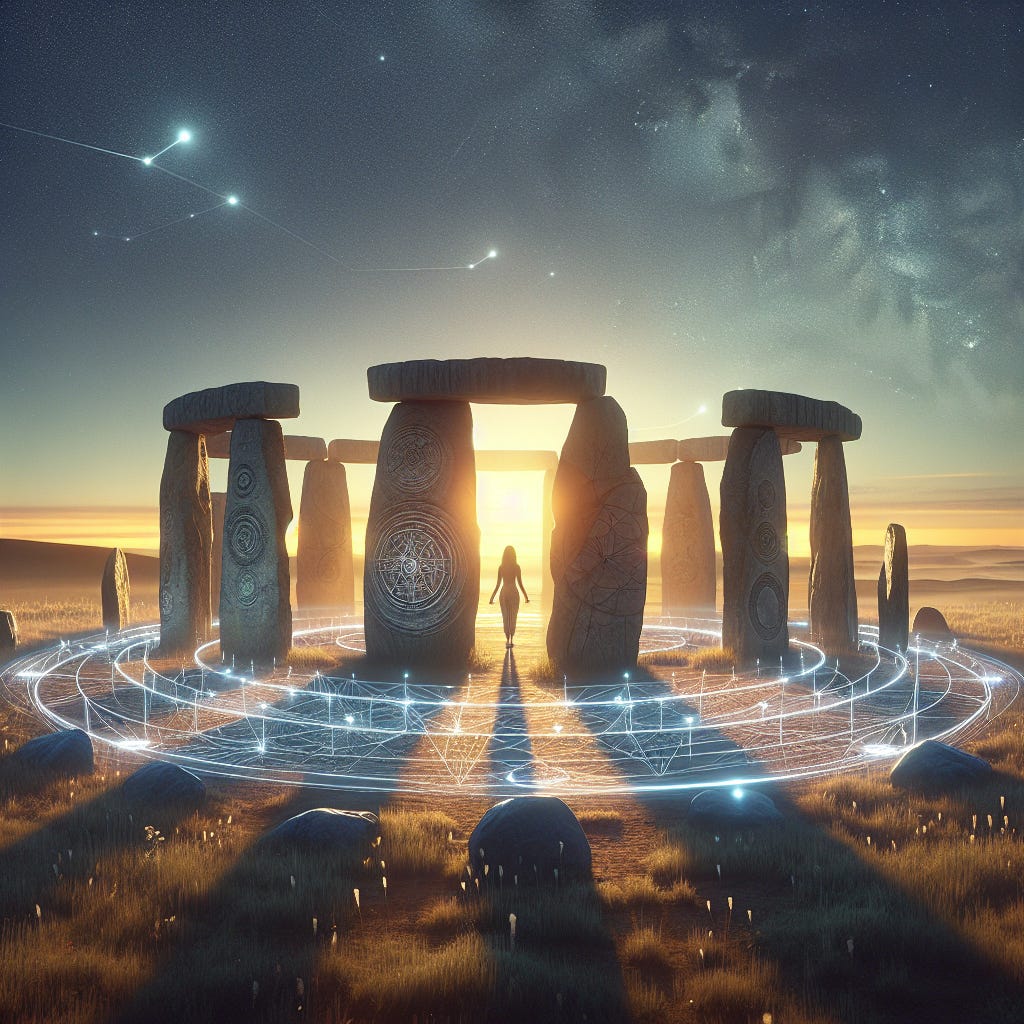
In exploring the relationship between the circle and cyclical time, we uncover profound insights into how this shape influences human consciousness and serves as a tool for conscious evolution. Ancient peoples observed the cyclical movements of celestial bodies, the sun’s daily arc, the moon’s phases, the seasonal rounds and recognized that time itself was not a straight line but a repeating spiral. Stone circles like Stonehenge and the medicine wheels of Indigenous cultures were constructed as both astronomical observatories and spiritual sanctuaries, aligning with solstices and equinoxes to mark the eternal return of light and darkness. These structures were not merely practical tools but living symbols of humanity’s connection to cosmic order. The circle, in this context, was a bridge between the earthly and the divine, a reminder that all life moves in cycles rather than along an unending, linear trajectory.
This perception of cyclical time stands in contrast to the modern Western worldview, which largely operates under a linear conception of history, an arrow of progress moving from past to future. Yet even within this framework, cyclical patterns persist. The enduring power of the circle as a symbol of time is perhaps most vividly expressed in monumental stone structures, structures that were not only feats of engineering but profound expressions of humanity’s attempt to align with the rhythms of the cosmos. Among these, Stonehenge in Wiltshire, England, stands as one of the most iconic and enigmatic. Constructed in phases between 3000 and 2000 BCE, this prehistoric stone circle is more than a relic of Neolithic Britain; it is a sophisticated timekeeping device, a celestial calendar etched in bluestone.
Stonehenge’s alignment with the solstices is precise and deliberate. On the summer solstice, the rising sun appears directly over the Heel Stone, casting a beam of light into the center of the monument, a moment that would have been both astronomically significant and spiritually potent. Similarly, the winter solstice sunset aligns with the opposite direction, marking the shortest day and the symbolic rebirth of the sun. These alignments suggest that the builders of Stonehenge were not only skilled astronomers but also ritualists who understood time as a sacred cycle, one that demanded observation, reverence, and participation.
But Stonehenge is not an isolated phenomenon. Across the globe, ancient cultures erected circular monuments that mirrored its purpose. In North America, the Bighorn Medicine Wheel in Wyoming, a stone structure radiating spokes from a central cairn, aligns with the rising and setting points of the sun during solstices and with certain bright stars, such as Aldebaran and Rigel. For the Indigenous peoples of the Plains, such wheels were not just tools for tracking time but sacred spaces for vision quests, healing, and communion with the spirit world. The circle here functions as a microcosm of the universe, a place where time, space, and consciousness converge.
What distinguishes the Bighorn Medicine Wheel from mere astronomical markers is its role as a living ceremonial space, a sanctuary where time, direction, and consciousness are woven into a unified field of spiritual practice. The wheel aligns with the solstices: on the summer solstice, the sun rises over a specific marker stone to the northeast, while on the winter solstice, it sets in alignment with another to the northwest. Additionally, the positions of bright stars such as Aldebaran (in Taurus), Rigel (in Orion), and Sirius (the Dog Star) correspond to key sighting points along the spokes, indicating that the builders were not only tracking solar and seasonal cycles but also mapping the heavens in a way that integrated stellar time into their cosmology.
Yet for the Indigenous peoples of the Plains, these alignments were never merely scientific. They were sacred. The medicine wheel was not a passive instrument for observation, but an active portal for transformation. It was and still is used as a site for vision quests, prayer, fasting, healing ceremonies, and rites of passage. The circle, in this context, becomes far more than a geometric shape; it becomes a container for consciousness, a sacred hoop that holds space for the individual to journey inward while remaining anchored in the greater order of the cosmos.
The very design of the medicine wheel reflects a holistic worldview. The central cairn represents the self, the heart, or the place of origin, the still point around which all life turns. The radiating spokes symbolize the directions, north, south, east, west, but also deeper metaphysical dimensions: the stages of life (birth, youth, adulthood, elderhood), the seasons (spring, summer, fall, winter), the elements (earth, air, fire, water), and the aspects of being (physical, emotional, mental, spiritual). In many traditions, a fifth direction, the center or the "above/below", is acknowledged, representing the unity of all things, the sacred presence that permeates and transcends the four quarters.
This multidimensionality is precisely what makes the circular form so conducive to meditation and visionary experience. Unlike linear spaces, which suggest progression, hierarchy, or separation, the circle is inherently egalitarian and inclusive. There is no beginning or end, no superior or inferior point, only a continuous flow. When one enters a medicine wheel, one steps into a space of balance, where all directions are equally honoured, and all parts of the self are invited to align. This symmetry creates a psychological and energetic resonance that quiets the mind, opens the heart, and prepares the spirit for deep introspection.

Vision quests, solitary fasts undertaken on sacred land, often atop mountains or within ceremonial circles, are central to many Indigenous spiritual practices. The Bighorn Medicine Wheel, surrounded by silence, thin air, and panoramic skies, provides an ideal environment for such quests. Participants may spend several days without food or water, exposed to the elements, in a state of heightened awareness. The circle acts as a boundary between the ordinary world and the realm of spirit, a consecrated space where prayers are amplified and visions are received. In this liminal state, between waking and dreaming, body and soul, the medicine wheel becomes a mirror of the cosmos, reflecting the seeker’s inner journey back to them in symbolic form.
The circular form enhances this process in several profound ways. First, it creates a sense of enclosure and safety, like the womb or the horizon, allowing the individual to let go of external distractions and turn inward. Second, its symmetry and balance help regulate the nervous system, inducing a meditative state naturally. Third, the act of walking the spokes, moving from the outer ring toward the center, or circling the perimeter, mimics the journey of the soul: outward into experience, inward toward essence. This movement is not random; it is ritualized, intentional, and often accompanied by prayer, song, or drumming, all of which deepen the trance-like state necessary for visionary insight.
In many Indigenous teachings, the medicine wheel is seen as a microcosm of the universe, a miniature cosmos laid out in stone. The circle mirrors the path of the sun across the sky, the cycle of the moon, the rotation of the stars, and the annual journey of Earth around the sun. To stand within it is to stand at the center of creation, to become a conscious participant in the turning of time. This is not egoic centrality, but sacred centrality, the recognition that each individual is a node in the vast web of life, connected to all directions, all beings, all times.
This understanding transforms the circle from a passive symbol into an active field of energy. When people gather within a medicine wheel for ceremony, their collective intention amplifies the space’s spiritual potency. Drumbeats echo in rhythmic cycles, voices rise in circular songs that repeat and evolve, and dancers move in spirals and orbits, mimicking the motion of planets and the flow of energy in nature. Time itself begins to feel different: not as a sequence of moments ticking forward, but as a living presence, a current that can be entered and ridden like a wave.
Other circular sacred sites across North America echo this function. The Mound Builder cultures of the Mississippi Valley constructed large earthen circles and mounds, such as those at Cahokia, which aligned with celestial events and served as ceremonial centres. The Sun Dance lodges of the Plains peoples are built as circular structures with a central pole representing the World Tree or Axis Mundi, the connection between Earth and Sky. Even the tipi, a portable dwelling, is circular in foundation, with its poles converging at the top like rays of the sun, and smoke flaps oriented to the four directions.
In all these forms, the circle is more than architectural; it is initiatory. It shapes consciousness. It invites the mind to release linear thinking and enter a state of cyclical awareness, where insight arises not through analysis but through receptivity, where knowledge is not acquired but remembered. This is the essence of the vision quest: not to seek something new, but to remember what has always been known at the soul level.
Modern neuroscience is beginning to validate what Indigenous wisdom has long understood: that rhythmic, circular environments and repetitive practices (such as chanting, drumming, or walking a labyrinth) can induce theta and alpha brainwave states, associated with deep meditation, creativity, and access to the subconscious. The medicine wheel, in this light, can be seen as an ancient neuro-spiritual technology, designed to entrain the brain and nervous system to the frequencies of the Earth and sky.
The circle’s power lies in its invitation to wholeness. In a world that often fragments identity, dividing mind from body, self from community, humanity from nature, the medicine wheel offers integration. It asks: “How are you in balance with the four directions of your being? Where are you out of alignment? What must be released, what must be honoured, what must be renewed?” These are not questions of logic, but of presence. And the circle holds the space for them to be asked and answered, without judgment.
In this way, the Bighorn Medicine Wheel and its kin are not relics of a forgotten past, but living teachers. They remind us that time is not merely measured in hours and dates, but in cycles of attention, intention, and transformation. They call us back to a way of being that is circular, not linear, that honours return, renewal, and relationship.
In the next post, we’ll explore the medicine wheel as a tool for self-discovery and integration. You’ll learn how to create your own wheel, map your inner landscape onto its four sacred directions, and transform it into a ceremonial space for reflection, healing, and personal growth.
Stay tuned!
Love Alloya