

Alchemical Triangle
Ancient Wisdom of Sulfur, Mercury, and Salt

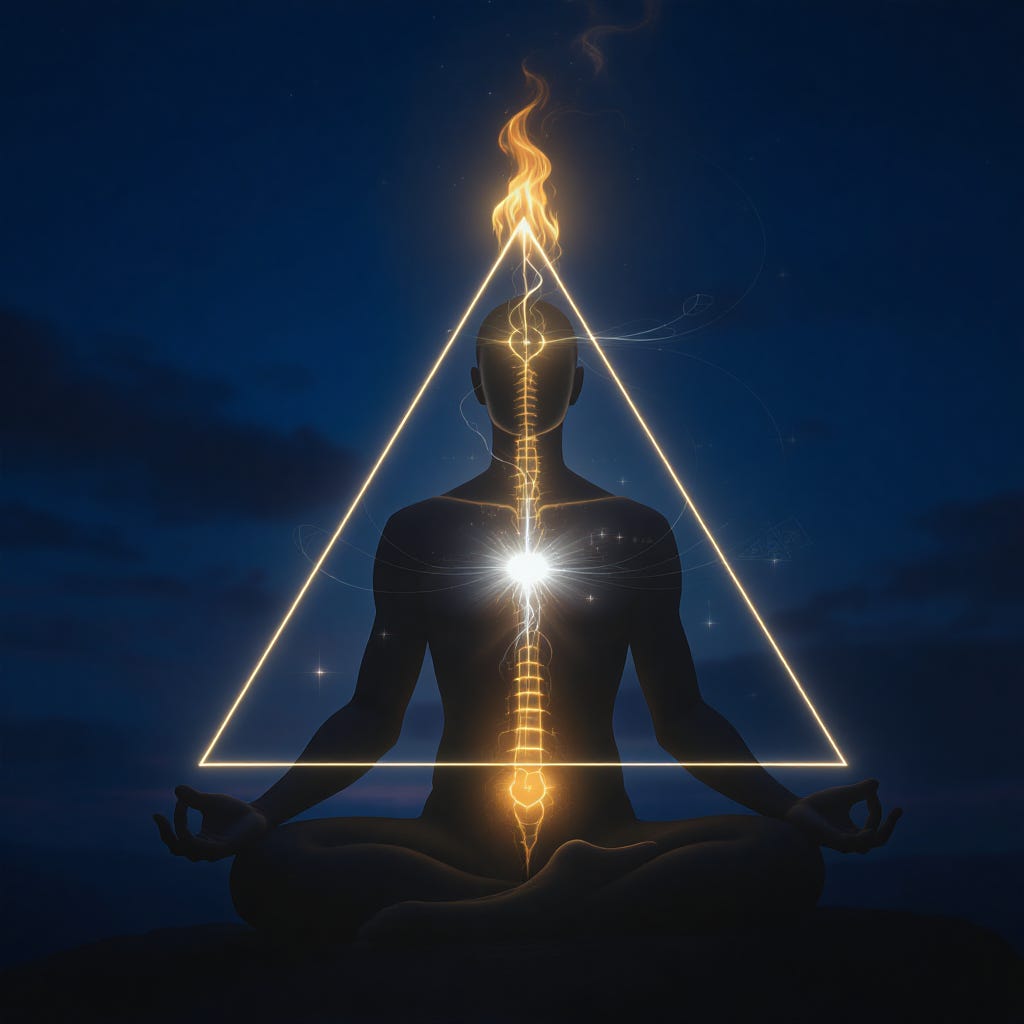
The Alchemical Triangle serves as a symbolic framework for understanding the universe and the self. It represents a balance between opposing but interconnected forces such as fire and water, spirit and matter, rising and falling, creation and decay. At its most basic, the triangle is the simplest polygon in geometry, yet also one of the most stable. This structural strength makes it a powerful metaphor for foundational systems. In alchemy, the triangle is more than a shape, it represents an ongoing process, a dynamic interaction of energies that are distinct yet part of a unified whole. At the core of this system are the three alchemical principles: sulfur, mercury, and salt. These are not physical substances but symbolic forces that represent essential aspects of all existence, both material and spiritual. Together, they form the basis of transformation in alchemical thought.
Sulfur, often associated with fire and the active, masculine principle, represents the spirit, the vital, creative, and transformative force within all things. In alchemical texts, sulfur is described as the "soul of the body," the inner fire that animates matter. It is the spark of life, the will to exist, the unceasing drive toward expression and evolution. Sulfur is not merely heat; it is the essence of desire, ambition, and consciousness. It is the force that propels the alchemist toward the Great Work, the inner fire that cannot be extinguished by external adversity. In ancient traditions, sulfur was linked to the sun, to the god Apollo, and to the principle of divine will. In the alchemical triangle, sulfur occupies the apex, the point of highest intensity, where spirit meets the divine.
Mercury, the second of the three primes, is the medium of transformation. It is the fluid, mutable, and elusive substance, neither fully solid nor liquid, but in constant motion. Mercury symbolizes the soul, the bridge between spirit and body, between the invisible and the visible. It is the principle of change, of adaptation, of integration. In alchemy, mercury is not only the metal but the universal spirit, the prima materia, the raw, unformed substance from which all things are made. It is the mind, the imagination, the subconscious, the dreamer. Mercury flows like water, yet it carries the light of fire. It is the mediator, the messenger between worlds, the substance that dissolves boundaries and reassembles them in new configurations. In the triangle, mercury occupies the center, the balancing point between the spiritual fire above and the material earth below. It is the soul that is neither pure spirit nor pure matter, but the alchemical agent of synthesis.
Salt, the third principle, represents the body, the material, tangible, and enduring aspect of existence. It is the foundation, the base of the triangle, the Earth upon which all else is built. Salt is not inert; it is essential for life, for preservation, for flavour. In alchemical thought, salt symbolizes the fixed, the stable, the completed form. It is the principle of cohesion, of structure, of finality. While sulfur ignites and mercury transforms, salt holds, contains, and manifests. It is the principle of embodiment, of incarnation, of the soul made visible in the world. Salt is the result of the alchemical process, the perfected body, the transmuted matter, the philosopher’s stone made manifest in the physical world. In the triangle, salt forms the base, the stable foundation from which the other forces rise.
Together, these three principles, sulfur, mercury, and salt, form the Alchemical Triangle, a symbol of the triune nature of existence. But this is not a static trinity; it is a dynamic, living process. The alchemist does not merely observe this triangle; he or she participates in it, becoming a living embodiment of its principles. The work of alchemy is not solely about transmuting lead into gold; it is about transforming the self. The Great Work, as it is called, is the inner journey of spiritual purification, of dissolving the ego, of integrating the shadow, and of achieving unity with the divine. The triangle, therefore, is not just a symbol of the cosmos; it is a map of the soul.
The alchemical triangle also reflects the structure of the human psyche, as later explored by Carl Jung. Jung saw the alchemical process as a metaphor for individuation, the journey of integrating the conscious and unconscious, the ego and the shadow, the masculine and feminine aspects of the self. The sulfur, mercury, and salt correspond to the anima and animus, the personal and collective unconscious, and the ego itself. The upward-pointing triangle represents the soul’s aspiration toward wholeness, while the downward-pointing triangle represents the descent into the depths of the unconscious, the confrontation with the shadow, and the integration of repressed aspects of the self. The alchemist, in Jungian terms, is the individual who undergoes this inner transformation, who faces the dark, dissolves the ego, and emerges reborn.
Jung viewed alchemy not as a primitive form of chemistry, but as a profound psychological system, one that mapped the inner development of the individual. For him, the Alchemical Triangle was more than an ancient symbol; it was a psychological model of transformation. The three principles, sulfur, mercury, and salt, were not just metaphysical ideas, but representations of deep structures within the psyche. Sulfur, as the inner fire and will, corresponds to the ego’s drive for meaning and self-realization, the conscious striving toward purpose. Mercury, as the fluid mediator, mirrors the unconscious itself, the realm of dreams, symbols, and instincts that connects the conscious mind with deeper layers of the self. Salt, as the fixed and material, represents the body, the personality as it is shaped by experience, and the grounded reality of lived existence.
In Jung’s framework, the alchemical process mirrors the process of individuation: the gradual integration of the self into a unified whole. The triangle becomes a diagram of this journey. The ascent from salt to sulfur, from matter to spirit, reflects the movement from unconsciousness to awareness. But this is not a linear climb. True transformation requires descent as much as ascent. The alchemist must go down into the nigredo, the blackening, the stage of decay, confusion, and confrontation with the shadow. This descent is symbolized by the downward-pointing triangle, often associated with water and dissolution. When the upward and downward triangles are combined, they form the hexagram, the star of Solomon, an image of balance, of opposites united, of psyche made whole.
Jung found in alchemical texts a symbolic language for the unconscious. The repeated imagery of death and rebirth, of purification through fire, of the union of opposites (the coniunctio oppositorum), all pointed to psychological truths long before modern psychology existed. The Alchemical Triangle, in this light, is not just a relic of esoteric tradition, but a functional model of inner work. The interplay of sulfur, mercury, and salt mirrors the dynamic between consciousness, the unconscious, and the self, the emergent center that arises when all parts are acknowledged and integrated.
For Jung, the goal of alchemy was never merely spiritual escape or material gain. It was wholeness. The philosopher’s stone was not a physical object, but a symbol of the realized self, the individual who has faced their darkness, transformed their conflicts, and achieved a state of inner unity. In this sense, the Alchemical Triangle is not just a guide to cosmic forces or ancient philosophy. It is a living symbol of psychological transformation, a structure that continues to illuminate the path from fragmentation to integration, from unconsciousness to self-knowledge. The alchemist’s laboratory, Jung concluded, was never outside the body, it was the human soul.
Meditative Exercise: Connecting with Your Soul Triangle
A Guided Practice to Align Sulfur, Mercury, and Salt Within
This meditation is designed to help you connect with the three alchemical principles, Sulfur (Spirit), Mercury (Soul), and Salt (Body), as inner forces within your being. Together, they form your personal Soul Triangle, a dynamic balance of will, awareness, and embodiment. This practice fosters self-awareness, integration, and inner harmony.
Preparation
Find a quiet space where you won’t be disturbed. Sit comfortably or lie down, spine straight, hands resting gently on your lap or at your sides. Close your eyes. Take three slow, deep breaths, inhaling through the nose, exhaling through the mouth. Let your body soften. Allow your mind to settle.
Set an intention: “I open myself to the wisdom within. I seek balance, clarity, and connection with my true self.”
Step 1: Grounding in Salt – The Body (Base of the Triangle)
Bring your awareness to your body. Feel its weight, its warmth, its presence.
Begin at the feet and slowly scan upward, ankles, calves, knees, thighs, feeling each part as real, solid, and alive.
Notice your breath moving through your chest, your belly rising and falling.
Salt is the foundation: your physical form, your history, your lived experience.
Say silently:
“I am here. I am grounded. I honor my body as the vessel of my journey.”
Visualize a soft, earthy glow, amber or deep brown, at the base of your spine. This is Salt: stability, containment, the wisdom of matter.
Breathe into this light. Let it grow, spreading through your limbs, anchoring you in the present.
Pause. Rest in this feeling of being fully embodied. (2 minutes)
Step 2: Awakening Sulfur – The Spirit (Apex of the Triangle)
Now shift your attention upward, to the crown of your head, to the space just above it.
Imagine a small flame, steady and bright, golden or crimson. This is Sulfur: your inner fire, your will, your longing for meaning.
Feel its warmth. This is the spark that drives you forward, the courage to be who you are, the desire to grow and create.
Say silently:
“I honor my inner fire. I am guided by purpose. I rise toward my highest self.”
Let this flame grow brighter, not with force, but with clarity. It does not burn, it illuminates.
Feel its energy descending slightly, not consuming, but inspiring.
Pause. Rest in this sense of aspiration and inner light. (2 minutes)
Step 3: Flowing with Mercury – The Soul (Center of the Triangle)
Now bring your awareness to the center of your chest, just behind the heart.
Here, imagine a silvery, shimmering presence, like liquid light, fluid and responsive. This is Mercury: the soul, the bridge, the messenger.
It is neither body nor spirit, but the awareness that connects them. It is your intuition, your dreams, your capacity to change and adapt.
Say silently:
“I am the flow between worlds. I listen. I transform. I carry wisdom from within.”
Feel Mercury moving, like a gentle current, linking the fire above and the earth below. It carries insights from the unconscious, soothes conflicts, and harmonizes opposites.
Watch as it flows upward to feed the flame, then downward to enliven the body.
Pause. Rest in this fluid, receptive awareness. (2 minutes)
Step 4: Uniting the Triangle
Now, see the three points connecting:
Salt below, glowing with earthy warmth.
Sulfur above, shining with steady fire.
Mercury in the center, flowing like liquid light between them.
Together, they form a triangle of energy within you, pointing upward, a symbol of integration.
With each breath, feel them aligning: body grounded, spirit inspired, soul mediating.
There is no need to force balance, simply allow each principle its place.
Stay here for several breaths, resting in the quiet unity of your inner triangle.
Closing
Gently release the images. Let the light dissolve into your being.
Take three deep breaths. Wiggle your fingers and toes. When you’re ready, open your eyes.
Carry this awareness with you. You may return to this practice daily, especially in times of confusion, transition, or inner conflict. The Soul Triangle is always within you, a living map of your transformation.
“As above, so within.”
Love Alloya